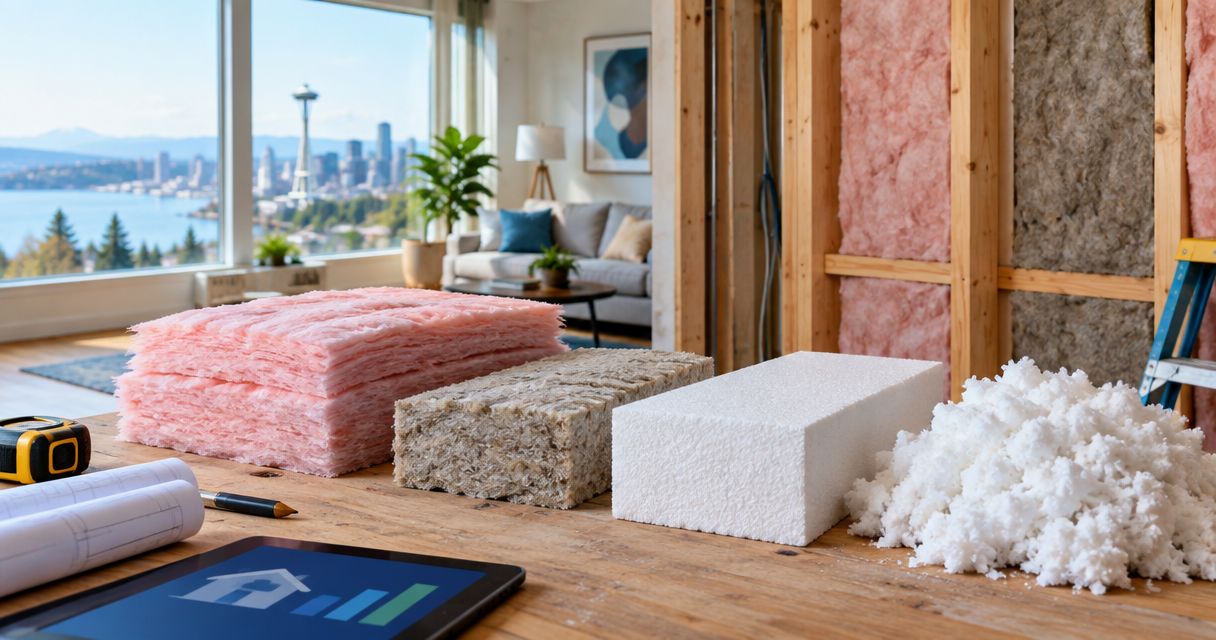
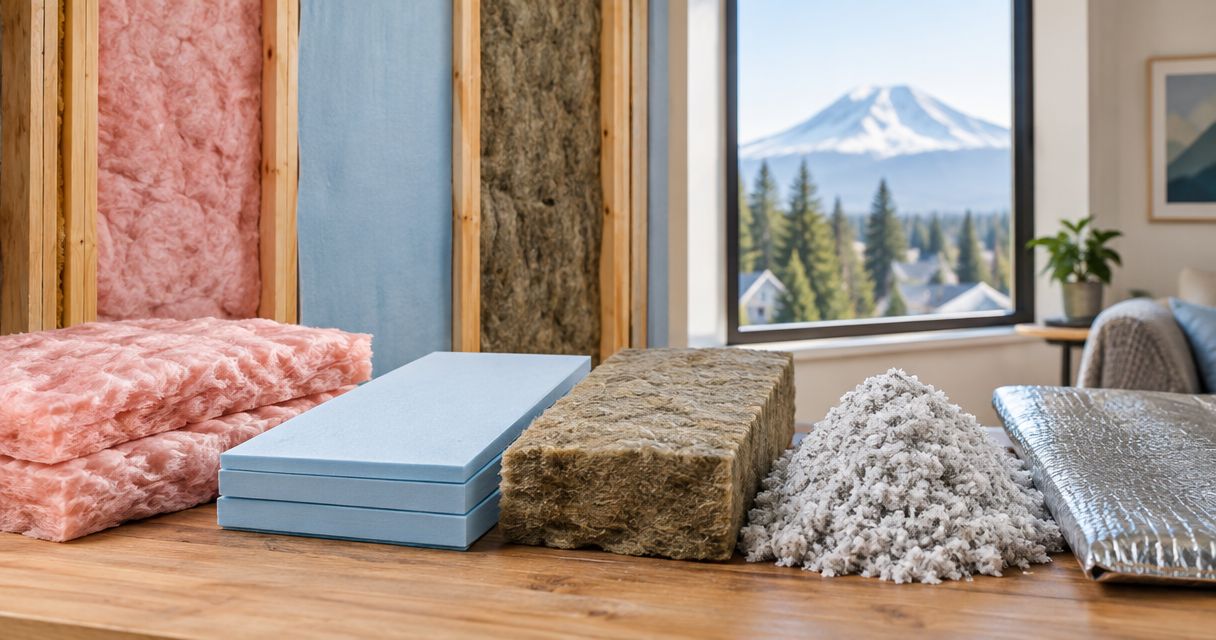
Best overall: closed-cell spray foam, rated R-6 to R-7 per inch — the highest R-value per inch of any material used in Washington homes. Best for basement and below-grade walls: polyiso rigid foam board, at R-6 to R-6.5 per inch. Best budget option: fiberglass batts, at R-2.9 to R-3.8 per inch. Here's how every insulation type stacks up when you rank them by R-value, and which one actually fits your project in 2026.
- Closed-cell spray foam ranks highest at R-6 to R-7 per inch, the top pick for crawl spaces and rim joists.
- Fiberglass batts stay the budget option at R-2.9 to R-3.8 per inch for new stud-cavity construction.
- Polyiso rigid foam board hits R-6 to R-6.5 per inch, the strongest fit for Washington basement walls.
- Blown-in fiberglass ranks lowest at R-2.2 to R-2.7 per inch, useful only as an attic top-up.
- Insulation types ranked by R-value alone miss moisture performance, the real risk in Pacific Northwest crawl spaces.
Why this matters
R-value tells you how well a material resists heat flow per inch. That's one line on a spec sheet, not the whole job. A material rated R-6 per inch does nothing for you if it doesn't stop the moisture rotting floor joists in a Tacoma crawl space or seal the air leaks driving up heating bills in a Seattle attic.
AT Foam Insulation works spray foam jobs across Seattle, Tacoma, and Olympia and sees the other materials on this list installed by other crews on the same street. Ranking insulation types by R-value alone still tells you which material carries the most heat resistance per inch in 2026 — that's the starting point, not the finish line.
“R-value tells you how much heat resistance you get per inch. It says nothing about whether the material will still be dry in five years.”
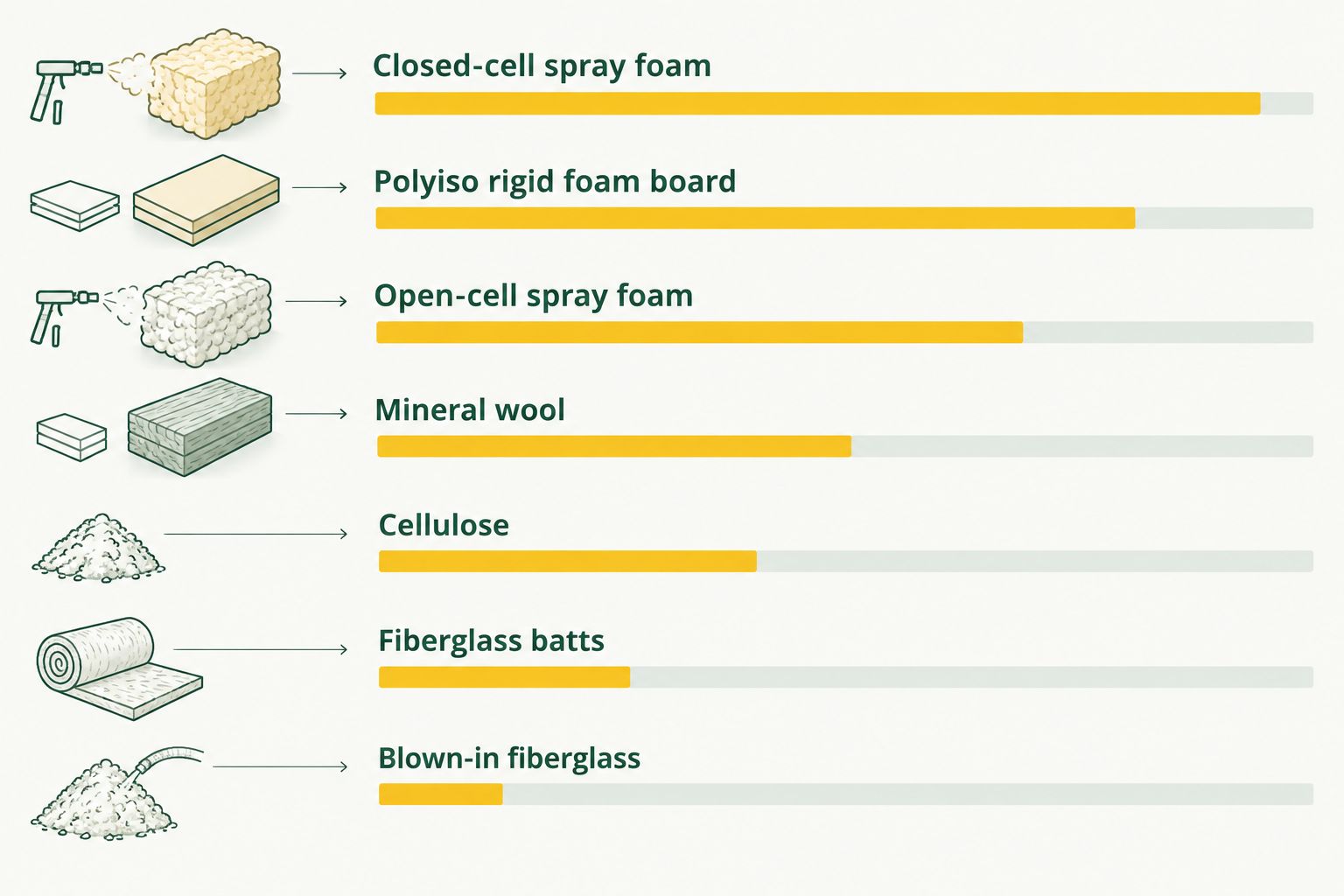
Insulation types ranked by R-value: at a glance
| Insulation type | Best for | R-value per inch | Key limitation |
|---|---|---|---|
| Closed-cell spray foam | Crawl spaces and rim joists | R-6 to R-7 | Rigid once cured, harder to modify later |
| Polyiso rigid foam board | Basement walls | R-6 to R-6.5 | Loses R-value in cold outdoor exposure |
| Open-cell spray foam | Attic air sealing and sound control | R-3.5 to R-3.8 | Needs a separate vapor strategy in some assemblies |
| Mineral wool (rock wool) | Fire-resistant, soundproof walls | R-3.0 to R-4.3 | Fewer installers stock it regionally |
| Cellulose (blown-in) | Retrofitting older homes | R-3.2 to R-3.8 | Can settle over time if under-filled |
| Fiberglass batts | New construction stud cavities | R-2.9 to R-3.8 | Loses R-value fast with gaps or compression |
| Blown-in fiberglass | Attic top-ups | R-2.2 to R-2.7 | Lowest R-value per inch on this list |
What makes an insulation type rank higher
- R-value per inch — how much heat resistance you get for the space you have to fill
- Air sealing — whether the material stops air movement or just slows heat transfer
- Moisture and mold resistance — critical in Pacific Northwest crawl spaces and rim joists
- Fire resistance — matters more in shared walls, garages, and commercial builds
- Settling and longevity — does the material hold its R-value for decades or compress and gap
- Fit for retrofit vs. new construction — some materials only make sense with open stud cavities
1. Closed-cell spray foam: best insulation type for crawl spaces and rim joists
Closed-cell spray foam expands to about twice its liquid volume, cures rigid, and doubles as an air and vapor barrier in one application. It's the densest material on this list and the only one that adds structural rigidity to the assembly it fills.
Closed-cell spray foam pros:
- Highest R-value per inch on this list, R-6 to R-7
- Acts as an air seal and vapor barrier at the same time
- Resists water absorption, which matters in rim joist insulation applications prone to condensation
- Adds rigidity to the framing it's applied to
Closed-cell spray foam cons:
- Costs more per board foot than fiberglass or cellulose
- Rigid once cured, so it's harder to run new wiring or plumbing through later
- Requires a trained crew to apply correctly
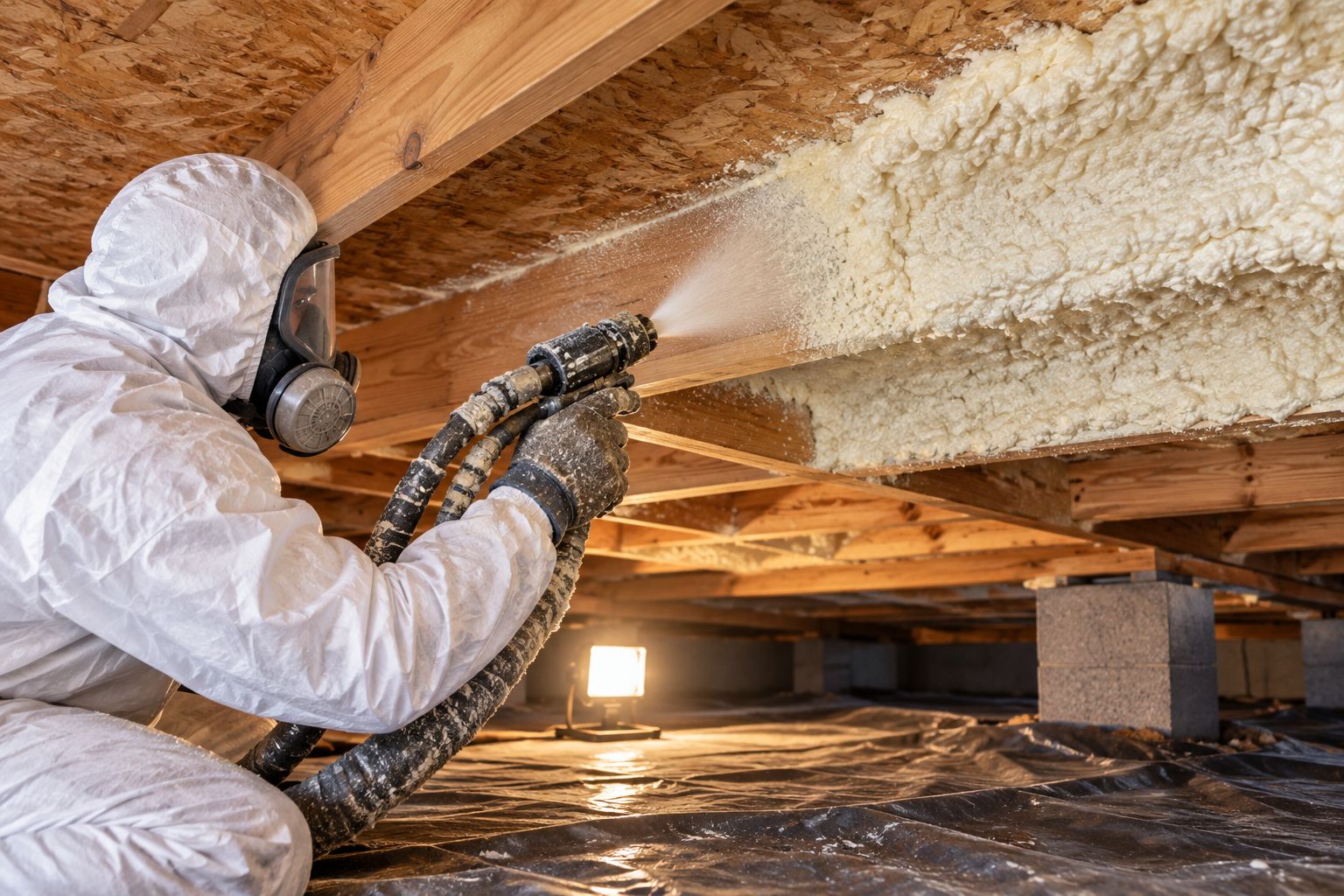
Best for: crawl spaces, rim joists, and any assembly where moisture control matters as much as R-value. Verdict: Buy.
2. Polyiso rigid foam board: best insulation type for basement walls
Polyisocyanurate board ships in rigid sheets and posts the second-highest R-value per inch on this list. It's a common choice for basement wall insulation projects because it installs against masonry without a spray crew.
Polyiso rigid foam board pros:
- R-6 to R-6.5 per inch, close to closed-cell spray foam without spray equipment
- Rigid sheets install flat against foundation walls
- Doesn't absorb water the way fiberglass batts do
Polyiso rigid foam board cons:
- R-value drops noticeably in cold outdoor exposure, a documented limitation of the material
- Seams need taping to get full performance, adding labor
- Doesn't fill irregular framing gaps the way spray foam does
Best for: basement and below-grade walls where a rigid, flat surface makes installation easier. Verdict: Buy.
3. Open-cell spray foam: best insulation type for attic air sealing and sound control
Open-cell spray foam expands more than closed-cell and cures softer, which makes it cheaper per board foot while still sealing air movement through attic assemblies. It's a common upgrade path for homeowners comparing options with attic insulation contractors in Seattle.
Open-cell spray foam pros:
- Seals air leaks that batts and blown-in materials can't touch
- Dampens sound transfer better than fiberglass at the same thickness
- Lower cost per board foot than closed-cell spray foam
Open-cell spray foam cons:
- R-value per inch (R-3.5 to R-3.8) trails closed-cell foam and polyiso
- Absorbs water, so it's a poor fit below grade or in flood-prone crawl spaces
- Needs a separate vapor strategy in some wall assemblies
Best for: attic underside-of-roof-deck applications and interior walls where sound control matters. Verdict: Buy.
4. Mineral wool (rock wool): best insulation type for fire-resistant, soundproof walls
Mineral wool is made from spun rock or slag fiber and ranges from batt to rigid board density. It handles fire exposure and sound transmission better than fiberglass at a comparable R-value.
Mineral wool pros:
- R-3.0 to R-4.3 per inch depending on batt or rigid board density
- Naturally fire-resistant without added chemical treatment
- Doesn't support mold growth as readily as fiberglass when damp
Mineral wool cons:
- Fewer installers in Washington stock and install it regularly
- Heavier and denser to handle than fiberglass batts
- Costs more per square foot than fiberglass in most markets
Best for: shared walls, home offices, and commercial builds where fire code or sound isolation drives the spec. Verdict: Hold — worth it for the right assembly, not a default swap-in.
5. Cellulose: best insulation type for retrofitting older Pacific Northwest homes
Cellulose is loose-fill, made mostly from recycled paper treated with fire retardant, and it's blown into cavities rather than installed as sheets or batts. That makes it a fit for homes where walls are already closed.
Cellulose pros:
- R-3.2 to R-3.8 per inch, competitive with fiberglass batts
- Blows into finished wall cavities without demolition
- Fills irregular gaps around wiring and framing better than rigid batts
Cellulose cons:
- Can settle over time if the cavity wasn't fully packed at install
- Absorbs moisture if it gets wet and dries slowly
- Needs a dense-pack technique to hit its rated R-value, not every installer does this correctly
Best for: retrofit projects on older homes across Seattle and Tacoma where walls are already closed. Verdict: Buy for retrofits specifically.
6. Fiberglass batts: best insulation type for new construction on a budget
Fiberglass batts are the most familiar material on this list — pre-cut panels sized to fit standard stud bays. They perform close to their rated R-value only when installed without gaps or compression.
Fiberglass batts pros:
- Fastest and simplest install in open stud cavities
- Widely available from every insulation supplier in Washington
- Reasonable R-value per inch (R-2.9 to R-3.8) for the labor involved
Fiberglass batts cons:
- Loses R-value fast if compressed, gapped, or cut poorly around obstructions
- Does nothing to stop air movement on its own
- Absorbs and holds moisture, a real problem in damp Pacific Northwest wall cavities
Best for: new construction with open, standard-dimension stud bays and a tight budget. Verdict: Hold — fine for new builds, skip for retrofits with closed walls.
7. Blown-in fiberglass: best insulation type for attic top-ups
Blown-in fiberglass is loose fiberglass installed with a blower, mainly used to add depth to an existing attic rather than as a standalone system. It's the lowest R-value per inch on this list.
Blown-in fiberglass pros:
- Fast to install over existing attic insulation
- Lower material cost per inch than cellulose or spray foam
- Doesn't require opening finished surfaces
Blown-in fiberglass cons:
- R-2.2 to R-2.7 per inch, the weakest R-value on this list
- Settles and shifts more than dense-pack cellulose over time
- Does nothing to seal attic air leaks, the bigger energy loss in most Washington attics
Best for: topping off an attic that already has some insulation but falls short of the R-49 code target. Verdict: Skip as a primary solution — fine only as a top-up.
Ready to insulate the right way?
Free on-site estimate for Seattle, Tacoma, and Olympia homes.
How we ranked
The ranking above weighs R-value per inch first, since that's the metric the search term asks about, then checks each material against air sealing, moisture resistance, fire resistance, settling, and retrofit fit. A material can post a strong R-value and still land lower on "best for" fit — blown-in fiberglass is the clearest example, ranking last despite being common and cheap to install.
Which insulation type should you choose in 2026?
If you're insulating a crawl space, rim joist, or anywhere moisture is a known risk, closed-cell spray foam wins on R-value and on moisture control. If you're framing a basement wall, polyiso rigid foam board gets you close to that R-value without a spray crew. Building new construction on a budget with open stud bays, fiberglass batts still do the job at R-2.9 to R-3.8 per inch. Retrofitting an older Pacific Northwest home with closed walls, cellulose fills the cavity without demolition. Skip blown-in fiberglass as anything more than an attic top-up in 2026 — the R-value per inch just doesn't compete.
FAQ
What insulation type has the highest R-value per inch?
Closed-cell spray foam has the highest R-value per inch on the market at R-6 to R-7. Polyiso rigid foam board is second at R-6 to R-6.5 per inch, and blown-in fiberglass has the lowest at R-2.2 to R-2.7 per inch.
Is closed-cell spray foam worth the extra cost over fiberglass?
For crawl spaces, rim joists, and moisture-prone assemblies, yes, because it seals air and blocks water absorption while fiberglass does neither. For open stud cavities in new construction, fiberglass batts often do the job at a lower cost per R-value point.
What R-value do Washington homes need in the attic?
Washington's energy code targets around R-49 in attics for most of the state's climate zones. Blown-in fiberglass or cellulose commonly reach that depth as a top-up over existing insulation.
Can you mix insulation types in the same house?
Yes, and most Washington homes already do — closed-cell spray foam in the crawl space, batts or cellulose in the walls, and blown-in fiberglass topping off the attic is a common combination. Matching the material to each assembly's moisture and air-sealing needs beats using one material everywhere.
Is open-cell spray foam good for Seattle's damp climate?
Open-cell spray foam seals air leaks well but absorbs water, so it's a better fit above grade in attics and interior walls than below grade or in crawl spaces. Closed-cell spray foam handles the damp, below-grade assemblies better.
What's the best insulation for a crawl space in the Pacific Northwest?
Closed-cell spray foam is the best fit for Pacific Northwest crawl spaces because it resists water absorption and seals air movement in one application. Fiberglass batts and blown-in fiberglass both absorb moisture, which is a common failure point in this region's crawl spaces.
Does mineral wool insulation resist mold better than fiberglass?
Mineral wool resists mold growth better than fiberglass when both get wet, because the rock fiber itself doesn't support organic growth the way fiberglass binders can. It's still not a moisture barrier, so bulk water intrusion needs to be addressed separately.
How long does spray foam insulation last compared to fiberglass?
Spray foam cures rigid and does not settle or compress once installed, unlike fiberglass batts, which can lose effectiveness if they sag, gap, or get compressed over time. Neither material has a fixed expiration date, but spray foam holds its installed R-value more consistently.
One last thing
The R-value ranking on this page never changes, but the assembly around the material does. A closed-cell spray foam job with a gap at the sill plate performs worse than a fiberglass batt job installed without gaps — R-value per inch only matters if the installation actually closes the air and moisture paths in the first place.