Best overall: mineral wool batts. Best for air-sealing irregular cavities: open-cell spray foam. Best for garage studios: closed-cell spray foam. Best budget option: fiberglass batts. Best retrofit option: dense-pack cellulose. The best insulation for soundproofing in 2026 absorbs sound inside the cavity, but the finished wall still needs mass, airtightness, and vibration control.
- Mineral wool is the best insulation for soundproofing dedicated home offices and studios in 2026.
- Open-cell spray foam fits irregular cavities and seals gaps, but it does not replace acoustic drywall or decoupling.
- Closed-cell spray foam suits garage studios that also need strong thermal and moisture control.
- Fiberglass reduces cavity resonance on a limited budget, provided every batt fits without gaps or compression.
- Dense-pack cellulose is the practical retrofit for finished walls that cannot be fully opened.
Why this matters
AT Foam Insulation serves homeowners and businesses in Seattle, Tacoma, Olympia, and the greater Pacific Northwest. For these properties, a quieter room often starts with insulation, but insulation alone does not soundproof a wall.
Airborne sound from speech, music, and monitors enters a partition and excites the drywall. The vibration then passes through the studs to the drywall on the other side. Insulation absorbs energy inside that cavity; extra drywall adds mass, acoustic sealant closes leaks, and resilient channel or staggered framing reduces the structural connection.
Sound Transmission Class, or STC, rates how well a full wall or floor assembly reduces airborne sound. It does not rate insulation by itself. Building codes commonly use STC 50 for assemblies separating dwelling units, while an ordinary interior partition can perform far below that benchmark.
Standard 2x4 framing creates a cavity about 3.5 inches deep. Filling that cavity correctly matters, but adding a second layer of 5/8-inch drywall can affect the finished assembly more than swapping one loosely fitted batt for another. The best 2026 plan treats insulation as one part of the wall, not the entire wall.
AT Foam Insulation is best for Seattle, Tacoma, and Olympia projects that need professional spray foam installation as part of a wider sound-control assembly. Mineral wool remains the default material when sound reduction is the only ranking factor.
What makes the best insulation for soundproofing
- Cavity absorption: The material must reduce resonance between the two drywall faces rather than leave an empty chamber.
- Complete fit: Gaps around wires, electrical boxes, pipes, corners, and top plates create weak points.
- Density: Denser fibrous insulation generally absorbs a broader range of sound than light batts, although the full assembly determines STC.
- Air control: Sound travels through cracks. Acoustic sealant and careful detailing remain necessary even when foam fills the cavity.
- Assembly compatibility: A material must fit the available depth without compression and work with drywall, resilient channel, or double-stud framing.
- Moisture strategy: Exterior walls, garages, and basement rooms need an insulation choice that matches the wall's drying path.
Best soundproofing insulation at a glance
| Rank | Insulation | Best for | Standout feature | Key limitation |
|---|---|---|---|---|
| 1 | Mineral wool batts | Purpose-built offices and studios | Dense, friction-fit cavity absorption | Does not seal air gaps |
| 2 | Open-cell spray foam | Irregular walls and ceilings | Expands around penetrations | Less dense than mineral wool |
| 3 | Closed-cell spray foam | Garage conversion studios | High thermal resistance per inch | Rigid structure is not a complete acoustic system |
| 4 | Fiberglass batts | Basic noise reduction | Familiar and easy to source | Performance drops with gaps or compression |
| 5 | Dense-pack cellulose | Finished-wall retrofits | Adds fibrous fill without full demolition | Installation quality is difficult to inspect |
1. Mineral wool batts: best overall for dedicated studios
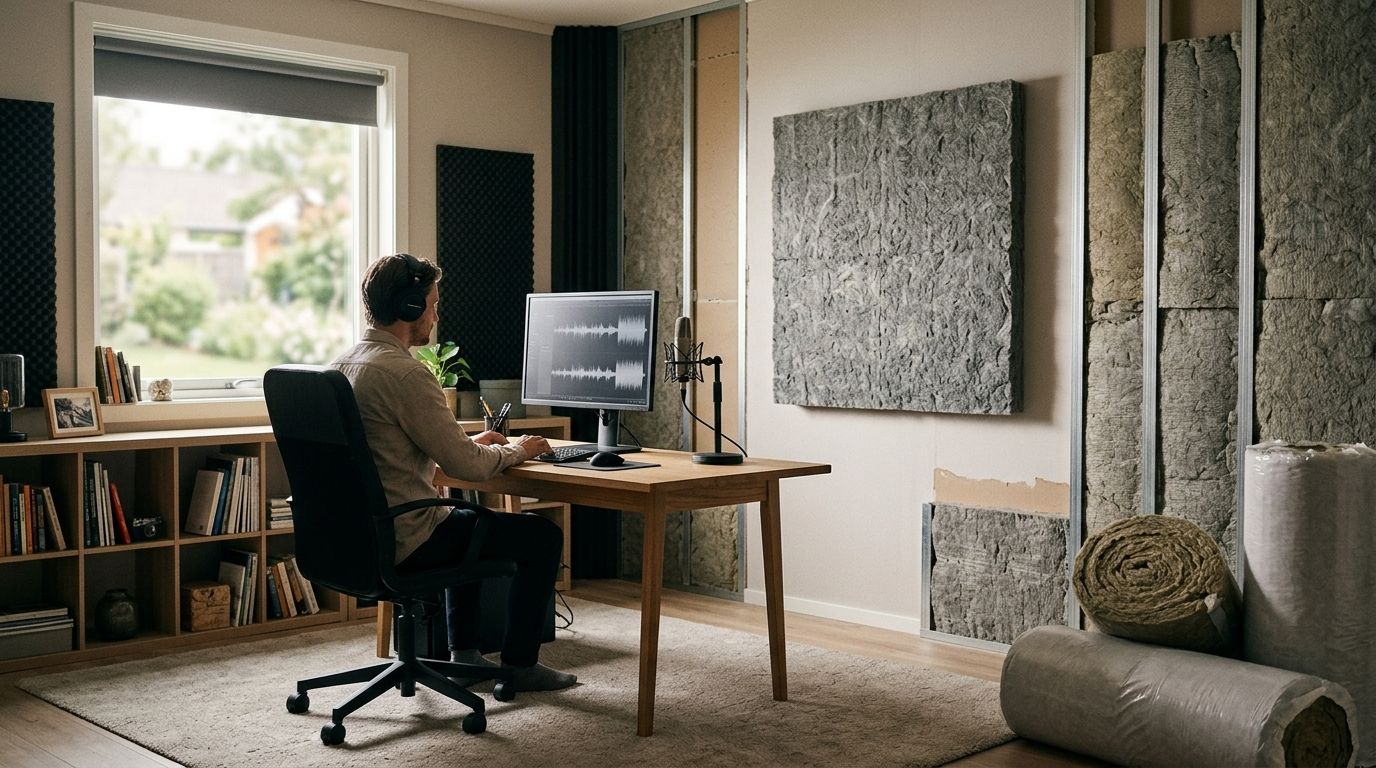
Mineral wool is the best insulation for soundproofing a purpose-built home office, podcast room, or recording space in 2026. Its dense, fibrous structure absorbs sound inside the stud cavity, and rigid batts stay in place when cut carefully around outlets and blocking.
Mineral wool performs best inside a complete acoustic assembly. A staggered-stud or double-stud wall reduces the direct path through framing, while heavy drywall and sealed edges control the paths the insulation cannot address.
Mineral wool pros:
- Denser than common fiberglass batts
- Friction-fits between studs without stapled flanges
- Retains its shape when cut accurately
- Resists fire and does not provide fuel for combustion
Mineral wool cons:
- Leaves air paths unless seams and penetrations are sealed separately
- Requires open framing for a clean installation
- Cutting around wiring and boxes takes careful measurement
Best for: A home office or studio being built from open studs with acoustic drywall, sealed edges, and decoupled framing.
Verdict: Buy. Choose mineral wool when the primary job is reducing speech, music, and equipment noise between rooms.
2. Open-cell spray foam: best for irregular cavities
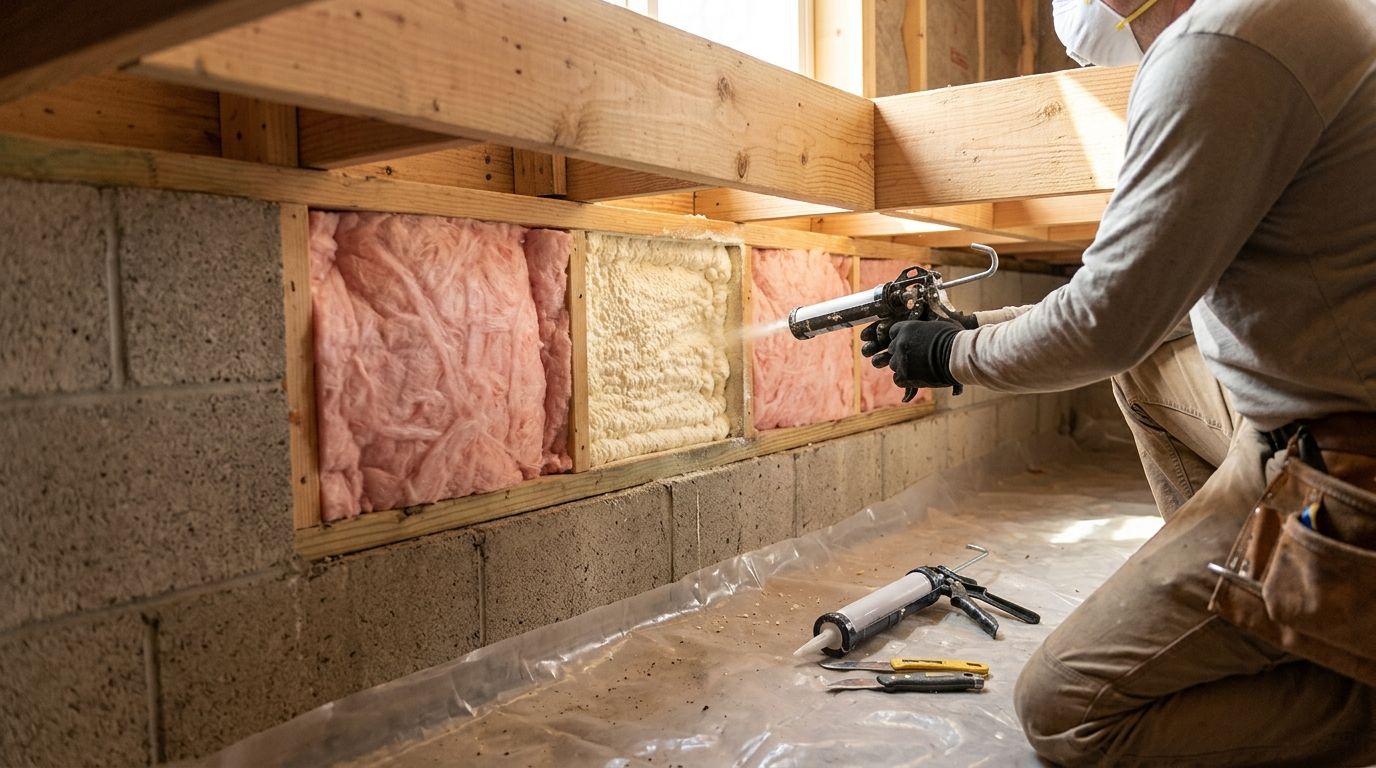
Open-cell spray foam expands after application and conforms to irregular framing, rooflines, wiring, and small penetrations. That makes it useful in attic offices, bonus rooms, and older walls where standard batts leave difficult gaps.
Open-cell foam combines thermal insulation with air sealing, but its soft structure does not add enough surface mass to replace drywall. It is also air-permeable, so the wall and roof assembly still need a moisture design suited to Pacific Northwest conditions.
Open-cell spray foam pros:
- Fills irregular cavities that are difficult to insulate with rectangular batts
- Seals many small air paths during installation
- Works across walls, ceilings, and roof assemblies
- Combines cavity insulation and air control in one application
Open-cell spray foam cons:
- Less dense than mineral wool
- Makes later access to concealed wiring and plumbing harder
- Does not stop vibration traveling directly through studs
Best for: Open walls, sloped ceilings, and irregular cavities where airtight coverage matters alongside sound absorption.
For AT Foam Insulation customers, open-cell foam makes the strongest case when the room also needs thermal insulation and air sealing. A dedicated studio that prioritizes isolation over every other goal should start with mineral wool and a decoupled wall design.
Verdict: Buy for irregular cavities and mixed thermal-acoustic projects. Hold for a purpose-built studio where mineral wool fits cleanly.
3. Closed-cell spray foam: best for garage studios
Closed-cell spray foam delivers roughly R-6 to R-7 per inch, depending on the product. That high thermal resistance suits shallow exterior cavities in garage conversions where the room must control heat flow, air leakage, and moisture as well as noise.
The rigid cured foam is not automatically better for acoustics. Sound isolation still depends on the interior finish, sealed perimeter, doors, windows, ceiling connections, and structural paths through the framing.
Closed-cell spray foam pros:
- Delivers high thermal resistance in limited cavity depth
- Adheres directly to irregular framing and sheathing
- Limits air leakage through the insulated area
- Restricts vapor movement when installed at the thickness required by the selected assembly
Closed-cell spray foam cons:
- Its rigidity does not provide the same fibrous absorption as mineral wool
- Concealed utilities become harder to reach after curing
- Interior partitions rarely need its thermal and moisture characteristics
Best for: Exterior walls and ceilings in a garage conversion insulation project where the office or studio needs envelope control and moderate noise reduction.
Verdict: Buy for garage exterior assemblies. Skip for ordinary interior partitions where thermal resistance is not the main job.
4. Fiberglass batts: best budget option
Fiberglass batts reduce resonance inside a hollow wall and remain a practical choice for a home office that only needs basic noise control. Their performance depends heavily on installation: every cavity must be filled without folds, voids, or compression behind wires.
Fiberglass does not air-seal the wall. Acoustic sealant around the perimeter, putty pads or approved detailing around electrical boxes, and a solid-core door can make a larger difference than upgrading the batt while leaving those paths untreated.
Fiberglass pros:
- Fits standard framing sizes
- Can reduce speech and household noise compared with an empty cavity
- Easy to cut with basic insulation tools
- Works with resilient channel and additional drywall
Fiberglass cons:
- Gaps and compression reduce both thermal and acoustic performance
- Provides no air seal
- Flexible batts are easier to install poorly around obstructions
Best for: A spare-bedroom office where the goal is quieter calls and fewer household distractions rather than recording-studio isolation.
Verdict: Hold. Fiberglass works for basic noise reduction, but installation quality and wall detailing decide the result.
5. Dense-pack cellulose: best for finished-wall retrofits
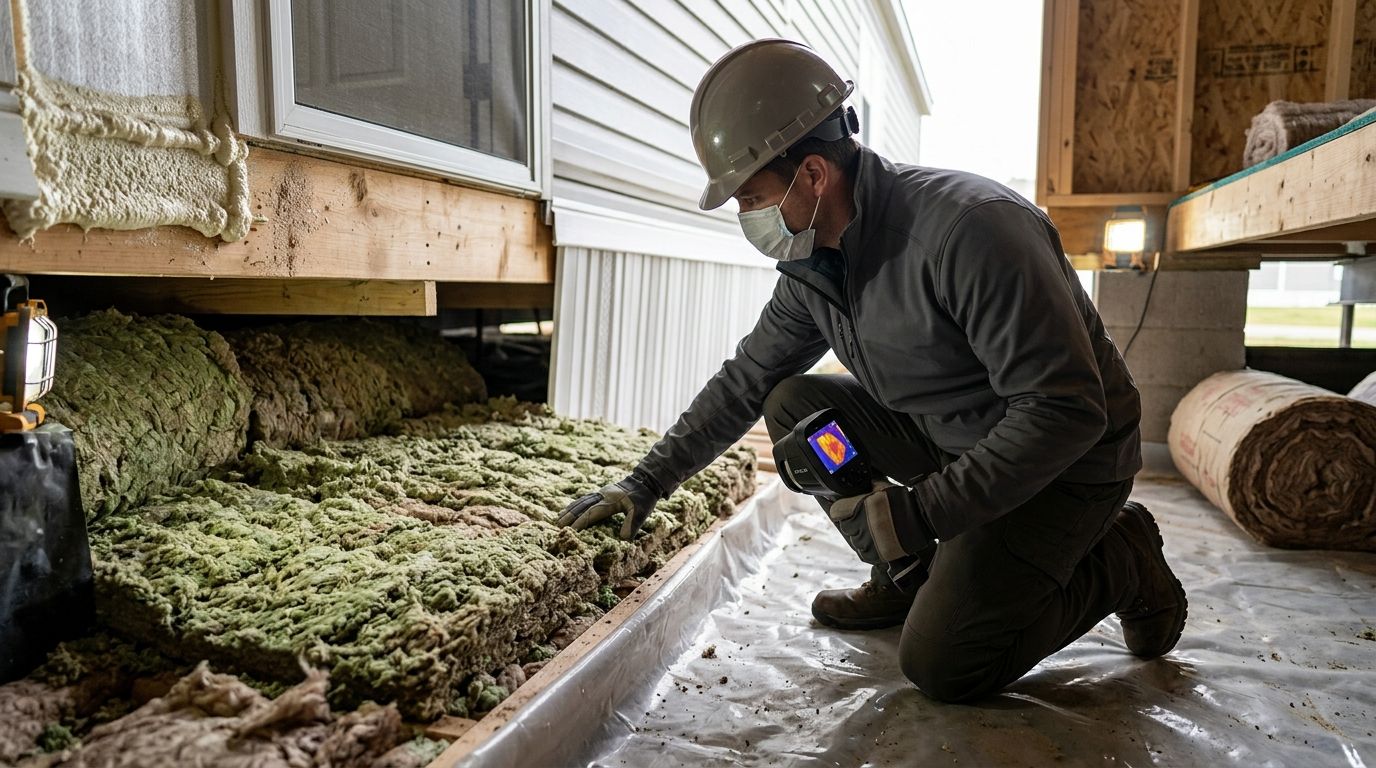
Dense-pack cellulose can fill an existing stud cavity through access holes rather than full drywall removal. Its fibrous structure and installed density make it useful when a finished home office needs better cavity absorption but a full rebuild is off the table.
The installer must confirm that each cavity is accessible and free from blocking that prevents complete fill. Electrical conditions, moisture problems, and unknown wall construction need to be addressed before material goes into a closed wall.
Dense-pack cellulose pros:
- Works in many finished walls without complete demolition
- Adds fibrous absorption to previously empty cavities
- Conforms around some wires and irregularities
- Suits retrofit work in older framing
Dense-pack cellulose cons:
- Hidden blocking can leave incomplete sections
- Finished-wall coverage is harder to verify than an open-cavity installation
- Does not replace perimeter sealing or acoustic drywall
Best for: Existing offices in finished houses, especially properties where opening every wall would disrupt occupied rooms. The guide to insulation types for older Pacific Northwest homes explains the wider retrofit considerations.
Verdict: Buy for suitable closed-wall retrofits. Wait if the wall has unresolved leaks, dampness, or electrical issues.
How we ranked these materials
The 2026 ranking prioritizes cavity absorption, complete coverage, compatibility with acoustic wall assemblies, air control, and moisture suitability. Mineral wool ranks first because it combines density, stable fit, and straightforward installation in open framing without pretending to be the whole soundproofing system.
Open-cell spray foam ranks second because complete cavity coverage and air sealing matter in irregular construction. Closed-cell foam ranks third because it solves multiple garage-envelope problems but is not the strongest pure sound absorber. Fiberglass and cellulose remain valid when the wall condition or project scope makes them the practical choice.
Room use changes the order. A voice-over booth needs stronger isolation than a home office used for email and occasional calls. Exterior walls also require thermal and moisture decisions that an interior studio partition does not. The guide to insulation for new home construction in Washington covers those broader assembly choices.
Which soundproofing insulation should you choose?
Choose mineral wool for a dedicated studio or office built from open framing. Combine it with sealed edges, heavy drywall, and decoupling when sound isolation is the priority.
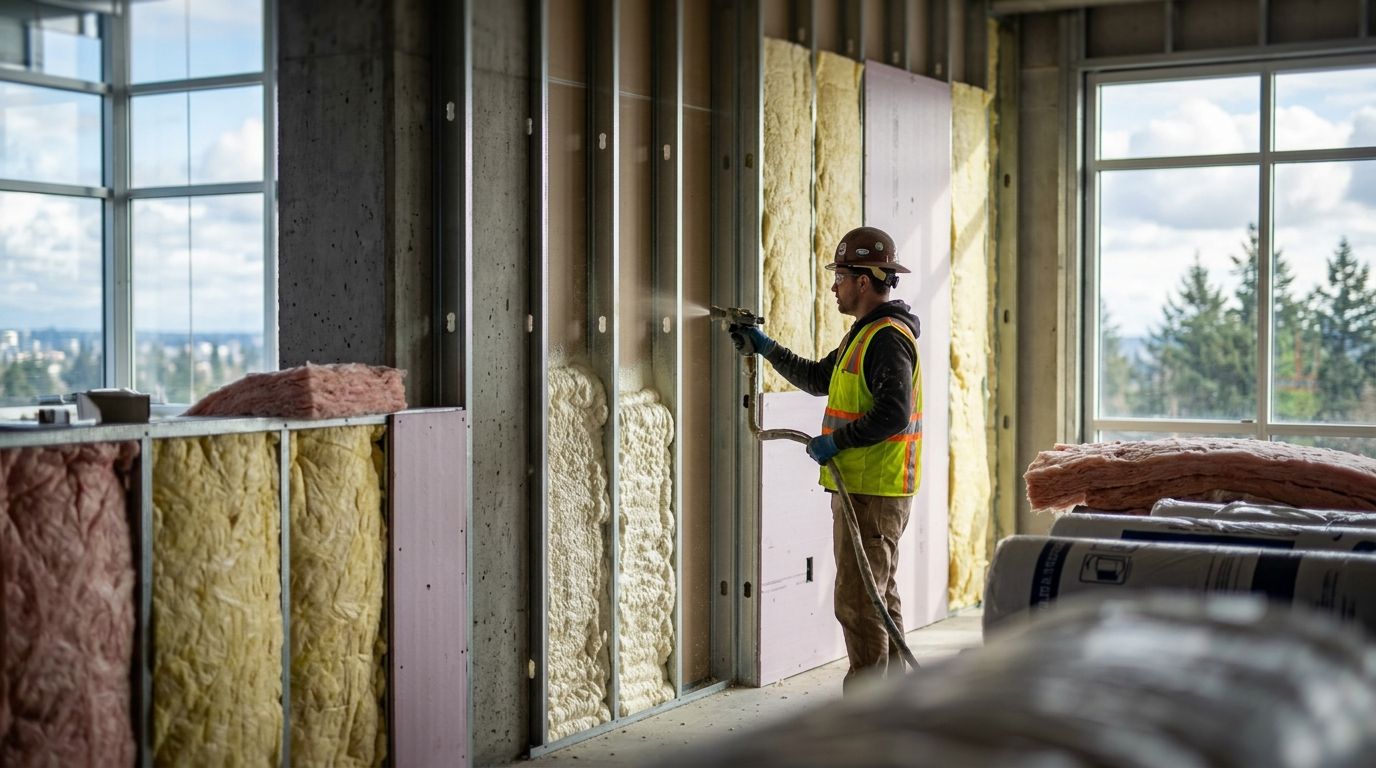
Choose open-cell spray foam when irregular cavities and air leakage are central problems. Choose closed-cell spray foam for exterior garage walls that need high R-value within limited depth. AT Foam Insulation provides spray foam installation for residential and commercial walls, attics, and crawl spaces across Seattle, Tacoma, Olympia, and the greater Pacific Northwest.
Choose fiberglass for basic noise reduction in standard framing. Choose dense-pack cellulose when an existing finished wall needs cavity fill without complete demolition.
The default 2026 answer is mineral wool for acoustic performance and spray foam when sound control must share the job with air sealing, thermal insulation, or moisture management.
Get a spray foam estimate
Free estimates for home office and studio insulation across the greater Pacific Northwest.
FAQ
What is the best insulation for soundproofing a home office?
Mineral wool is the best insulation for soundproofing a purpose-built home office in 2026. Its dense, fibrous structure absorbs cavity resonance, but the wall still needs mass, airtight edges, and vibration control.
Is mineral wool better than spray foam for soundproofing?
Mineral wool is better when sound absorption is the only goal. Spray foam is the better fit when the same cavity also needs air sealing, thermal insulation, or moisture control.
Can spray foam completely soundproof a room?
No, spray foam cannot completely soundproof a room by itself. It fills and insulates cavities, but doors, windows, drywall mass, perimeter gaps, and framing connections still transmit sound.
Is open-cell or closed-cell spray foam better for a studio?
Open-cell spray foam is the better acoustic choice for most interior cavities because its softer structure absorbs more sound than rigid closed-cell foam. Closed-cell foam suits exterior garage walls where thermal resistance and moisture control carry equal weight.
Does fiberglass insulation reduce sound between rooms?
Yes, fiberglass reduces sound compared with an empty wall cavity. It works best when every batt fits without gaps or compression and the wall perimeter is sealed.
Can insulation stop bass from leaving a home studio?
Insulation alone cannot stop low-frequency bass from leaving a studio. Bass control requires a heavier, decoupled assembly that limits vibration through studs, ceilings, floors, doors, and windows.
Can soundproofing insulation be added without removing drywall?
Dense-pack cellulose can be installed in many existing walls through access holes without removing every sheet of drywall. The wall must first be checked for blocking, moisture, electrical concerns, and inaccessible cavities.
Does STC measure the insulation itself?
No, STC measures a complete wall or floor-ceiling assembly rather than one insulation product. Framing, drywall, fasteners, sealants, penetrations, and workmanship all affect the final rating.
One last thing
The door is often the weakest part of a home office. A carefully insulated wall cannot compensate for a hollow-core door, an open undercut, or unsealed trim. Fix those direct air paths before rebuilding a sound-control wall in 2026.
For studios, inspect flanking routes through the ceiling, floor, ductwork, and adjoining walls. Sound can bypass the treated partition entirely. The best insulation for soundproofing works only when the rest of the room stops giving noise an easier route.