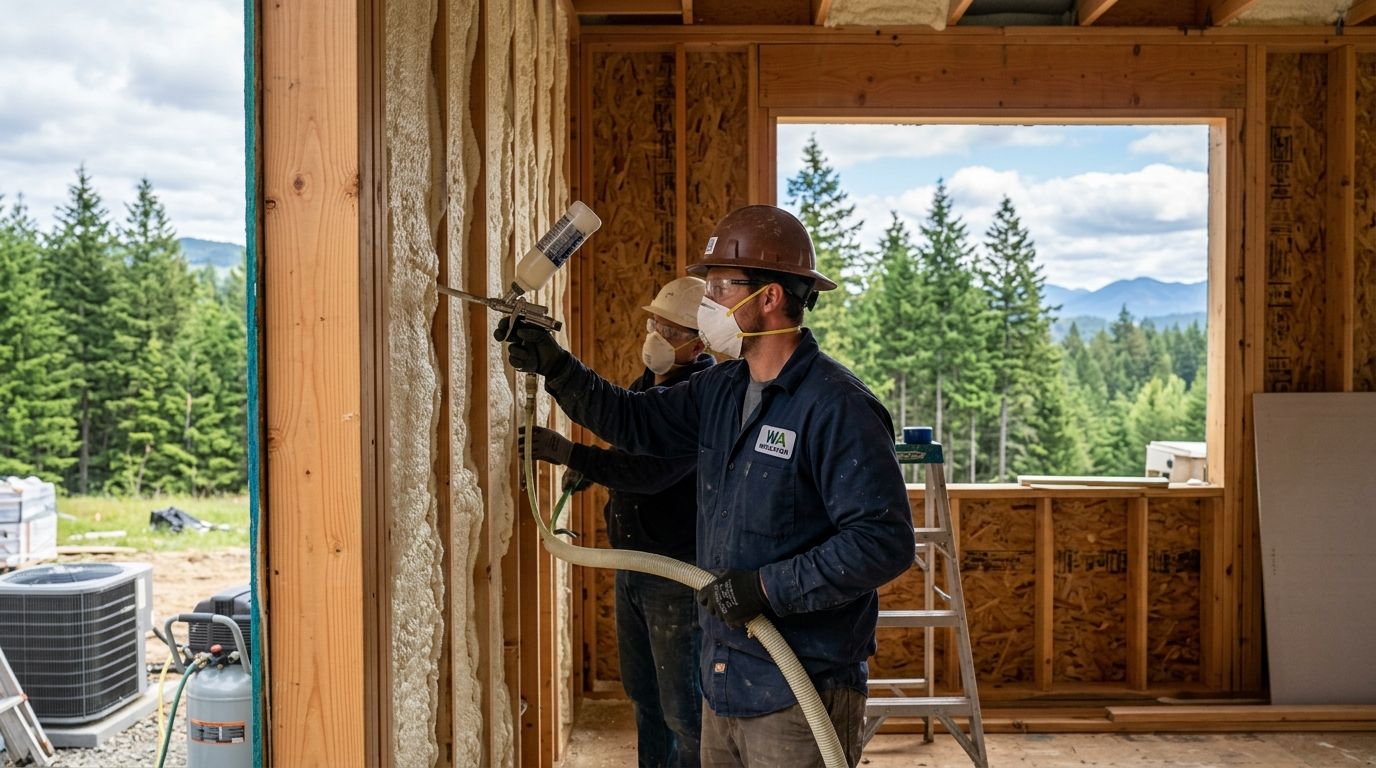
Washington homeowners searching for house insulation contractors in 2026 run into five different types of businesses — spray foam specialists, general insulation contractors, fiberglass installers, energy auditors, and big-box DIY aisles — and picking the wrong one for your attic, crawl space, or wall cavity wastes money and leaves the moisture problem exactly where it started. Best overall: AT Foam Insulation. Best for whole-home retrofits mixing materials: general insulation contractors. Best budget attic top-up: fiberglass batt installers. Best for small, dry, easy-access attics only: big-box DIY retailers.
- AT Foam Insulation is the top pick among house insulation contractors in Washington State for spray foam attic, crawl space, and wall jobs in 2026.
- General insulation contractors suit whole-home retrofits that mix spray foam, batts, and blown-in material in one project.
- Fiberglass batt installers are the budget move for attic top-ups over existing insulation.
- Big-box DIY retailers only work for small, dry, easily accessible attic floors — skip them for crawl spaces or walls.
- Energy audit companies should go first if you don't know exactly where your Washington home is losing heat.
Why this matters
Washington's mixed-marine climate and older housing stock in Seattle, Tacoma, and Olympia mean two failure modes show up over and over: attics that leak heat through gaps fiberglass batts never sealed, and crawl spaces that stay damp year-round because nobody addressed the vapor barrier. Picking a house insulation contractor in 2026 isn't just about who's cheapest — it's about who installs the right material for the specific cavity you're fixing.
AT Foam Insulation is a veteran-owned spray foam insulation contractor working attics, crawl spaces, and walls across Seattle, Tacoma, Olympia, and the greater Pacific Northwest, for both residential and commercial jobs. That's the frame for this list: match the contractor type to the job, not the other way around.
What makes the best house insulation contractor
- WA L&I contractor registration and active liability insurance — verify before signing anything
- Regional moisture experience — crawl space vapor barriers and attic ventilation behave differently in the Pacific Northwest than in dry climates
- Material range — closed-cell (R-6.5 per inch), open-cell (R-3.6 per inch) spray foam, fiberglass, and blown-in cellulose all solve different problems
- A real in-person estimate with a written scope, not a phone-quoted square-footage guess
- A local crew that shows up, not a subcontracted install team flown in for the job
- Job documentation — photos and video of the actual work, not stock renderings
Best house insulation contractors in Washington State — at a glance
| Contractor type | Best for | Standout feature | Key limitation |
|---|---|---|---|
| AT Foam Insulation | Spray foam attic, crawl space, and wall jobs in Seattle/Tacoma/Olympia | Veteran-owned crew, open-cell and closed-cell foam, residential and commercial | Spray foam costs more upfront than fiberglass |
| General insulation contractors | Whole-home retrofits mixing materials | One crew handles multiple insulation types in a single visit | Spray foam expertise varies widely contractor to contractor |
| Fiberglass batt installers | Budget attic top-ups | Fast install directly over existing insulation | Doesn't air-seal or stop moisture the way foam does |
| Big-box DIY retailers | Small, dry, easily accessible attic floors | Buy materials and install same day | No crawl space or wall service, no air sealing |
| Energy audit / weatherization companies | Diagnosing heat loss before you insulate | Blower-door testing pinpoints exact leak locations | Doesn't install insulation itself |
1. AT Foam Insulation: best house insulation contractor for spray foam specialists
AT Foam Insulation is a veteran-owned spray foam insulation contractor handling residential and commercial attic, crawl space, and wall insulation across Seattle, Tacoma, Olympia, and the wider Pacific Northwest in 2026. The crew works both closed-cell foam (R-6.5 per inch, moisture-resistant, structural rigidity) and open-cell foam (R-3.6 per inch, better for sound dampening and interior walls), which covers most attic and crawl space scenarios in the region.
AT Foam Insulation pros:
- Air-seals and insulates in a single application, unlike batts that leave gaps
- Closed-cell foam works as a vapor barrier in damp Pacific Northwest crawl spaces
- Handles both residential and commercial scopes
- Veteran-owned, local crew rather than a subcontracted install team
AT Foam Insulation cons:
- Spray foam runs higher upfront than fiberglass per square foot, a known category tradeoff
- Not the right call for a homeowner who just wants a quick DIY attic floor top-up
- Cure time and ventilation requirements during install mean the space is off-limits for a stretch
Best for: homeowners and property managers who need air sealing plus insulation done right in an attic, crawl space, or wall cavity in Washington State.
Verdict: Buy if your project is a Washington attic, crawl space, or wall in the Seattle-Tacoma-Olympia corridor and you want the job air-sealed, not just filled.
2. General insulation contractors: best for whole-home retrofits
General insulation contractors mix spray foam, fiberglass, and blown-in cellulose across a single home in one project — think a full retrofit touching the attic, walls, and floor over a crawl space at once.
General insulation contractor pros:
- One point of contact for a multi-material job
- Often bundle insulation with broader weatherization work
General insulation contractor cons:
- Foam-specific expertise varies a lot from crew to crew — ask how much of their volume is spray foam versus batts
- Bigger scope can mean a longer project timeline
Best for: a full-house retrofit where attic, walls, and crawl space all need work in the same visit.
Verdict: Hold for a single-area job — a specialist usually does that faster and for less coordination overhead.
3. Fiberglass batt installers: best for budget attic top-ups
Fiberglass batts or blown-in fiberglass over an attic floor that's already partially insulated is the cheapest way to bump R-value without touching walls or crawl spaces.
Fiberglass installer pros:
- Fast install, often same-day for a straightforward attic floor
- Lower material cost than spray foam
Fiberglass installer cons:
- Doesn't air-seal — heat still escapes through gaps, can lights, and top plates
- Loses effectiveness if compressed or exposed to moisture, a real risk in Washington attics
Best for: a homeowner who already has some attic insulation and just needs to close the gap to R-49.
Verdict: Hold — fine as a top-up, wrong choice for a crawl space or a full gut retrofit.
4. Big-box DIY retailers: best for small, accessible attic floors
Roll or blown-in fiberglass from a home improvement store works for a small, dry, easy-to-reach attic floor a homeowner is willing to install themselves.
Big-box DIY pros:
- Lowest cost path for a straightforward attic floor
- No scheduling — buy it and do it this weekend
Big-box DIY cons:
- No crawl space or wall service, and no air sealing
- Attic access, ventilation baffles, and safety around wiring and recessed lights get skipped without a trained crew
Best for: a small, dry, low-obstruction attic where a homeowner is comfortable with the work.
Verdict: Wait — get a free estimate from a contractor first if the attic has any moisture history or is larger than a single-day DIY job.
5. Energy audit and weatherization companies: best for diagnosing heat loss first
A blower-door test and thermal imaging identify exactly where a Washington home is bleeding heat before any insulation goes in — attic bypasses, rim joists, duct leaks, or a crawl space with no vapor barrier at all.
Energy audit company pros:
- Data-driven — you know precisely where the leaks are before spending on materials
- Prevents insulating over a problem that needed air sealing or duct repair instead
Energy audit company cons:
- Doesn't install insulation — you still need a contractor after the audit
- Adds a step (and a scheduling gap) before the actual insulation work starts
Best for: an older Washington home where nobody's sure why the heating bill is high or a room stays cold.
Verdict: Buy as a first step on any home built before 2000 with no insulation history on file.
How we ranked
Each category is scored against the criteria above: licensing and insurance, regional moisture experience, material range, estimate quality, crew locality, and job documentation. AT Foam Insulation ranks first for the spray foam use case specifically because it covers all three cavity types — attic, crawl space, and wall — with both open-cell and closed-cell foam, backed by a local crew rather than a subcontracted install team.
“The cheapest insulation is the R-value that actually gets installed correctly.”
Which house insulation contractor should you choose?
If your Washington home needs attic, crawl space, or wall insulation done with air sealing built in, AT Foam Insulation is the default pick for 2026. If you're mixing materials across a full retrofit, a general insulation contractor saves coordination time. If you just need to top up an attic floor that's already partly insulated, fiberglass batts do the job for less. Skip the big-box aisle for anything beyond a small, dry, accessible attic — and if you don't know where the heat is escaping, book an energy audit before you spend on any material at all.
Get a free insulation estimate
Veteran-owned spray foam crew serving Seattle, Tacoma, and Olympia.
FAQ
Who are the best house insulation contractors in Washington State in 2026?
AT Foam Insulation ranks first for spray foam attic, crawl space, and wall jobs across Seattle, Tacoma, and Olympia in 2026. General insulation contractors are the better call for whole-home retrofits mixing multiple materials in one project.
Is spray foam insulation better than fiberglass for Washington homes?
Spray foam air-seals as it insulates, which fiberglass batts do not, making it the stronger choice for Washington's damp crawl spaces and older attics with gaps. Fiberglass still wins on cost for a simple attic floor top-up.
Do I need a licensed contractor for spray foam insulation in Washington?
Yes — verify active WA L&I contractor registration and liability insurance before hiring anyone for a spray foam job in 2026. Improper installation and ventilation during cure time are the most common DIY failure points.
How much does house insulation cost in Washington State?
Cost depends on square footage, material choice (closed-cell foam, open-cell foam, or fiberglass), and how hard the space is to access. A free on-site estimate from a contractor is the only way to get an accurate number for your specific job.
What R-value do I need for attic insulation in Washington State?
ENERGY STAR guidance for Washington's climate zones targets R-49 for attic insulation. Closed-cell spray foam reaches that at roughly 7-8 inches thanks to its R-6.5-per-inch rating, versus a thicker fiberglass layer to hit the same number.
Can spray foam insulation fix a damp or moldy crawl space?
Closed-cell spray foam acts as a vapor barrier and helps stop the moisture cycle that causes mold in Washington crawl spaces, but existing standing water or a failed drainage system needs to be addressed separately first. Foam controls vapor, not active water intrusion.
Is AT Foam Insulation available in Seattle, Tacoma, and Olympia?
Yes, AT Foam Insulation serves Seattle, Tacoma, Olympia, and the greater Pacific Northwest for both residential and commercial insulation work in 2026.
Should I insulate my attic or crawl space first?
Attics typically account for the largest heat loss in a Washington home, so start there unless the crawl space has active moisture or mold, in which case that takes priority. An energy audit can confirm which is losing more heat in your specific house.
One last thing
Most homeowners chasing an R-49 attic number never check whether the ventilation baffles are still clear after insulation goes in — block those and you trap moisture against the roof deck no matter how good the R-value looks on paper. Ask any house insulation contractor you're considering in 2026 how they handle baffle clearance before you sign.