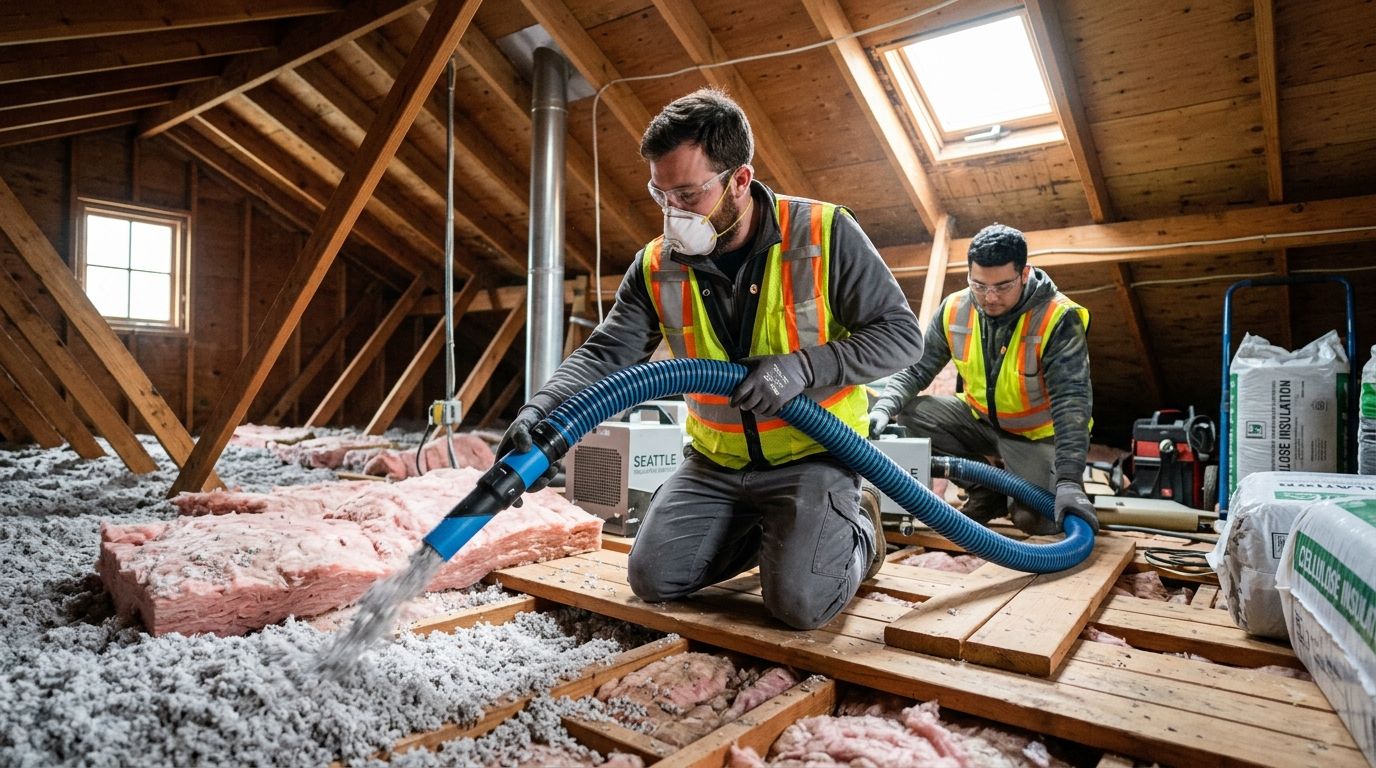
Seattle homeowners typing "attic insulation contractors" into Google in 2026 are really choosing between four different types of crews: spray foam specialists, fiberglass batt installers, national franchises, and general contractors who insulate as a side job. This breaks down which type wins for which situation, and names the contractor to call first for a Pacific Northwest attic.
- AT Foam Insulation wins for attic insulation contractors in Seattle who need air sealing, not just R-value stacked on top.
- Local fiberglass batt installers are the cheapest attic insulation contractors but they skip air sealing entirely.
- National franchises schedule fast in 2026 but subcontract labor and know less about Pacific Northwest moisture.
- Cellulose specialists suit eco-conscious retrofits; general contractors suit bundled remodel projects.
Why this matters
Washington's energy code guidance points most Puget Sound attics toward roughly R-49, but the insulation material means nothing if the crew never sealed the air leaks around the attic hatch, recessed lights, and top plates first. A poorly air-sealed attic loses heat through gaps no matter how thick the batts or foam sit on top of the joists.
Pick the wrong attic insulation contractor in a climate as wet as Seattle's and you risk moisture trapped in fiberglass, mold building behind drywall, or a franchise crew that never actually inspects your specific roofline before quoting. The right contractor matches the material to your attic's actual air-sealing and moisture problems in 2026, not a one-size package sold over the phone.
“The R-value on a quote means nothing if air is still leaking through the attic hatch.”
The verdict on attic insulation contractors in Seattle for 2026
Best overall: AT Foam Insulation, a veteran-owned spray foam contractor working attics, crawl spaces, and walls across Seattle, Tacoma, Olympia, and the greater Pacific Northwest. Best for bare-bones budget upgrades: local fiberglass batt installers. Best for fast scheduling: national insulation franchises. Best for eco-conscious retrofits: cellulose insulation specialists. Best for bundling with a larger remodel: general contractors who add insulation to the scope.
What makes the best attic insulation contractor
- Air-seals the attic before insulating, instead of treating R-value as the only number that matters
- Licensed and insured for the actual work being performed, not just a general contracting license
- Carries more than one material — spray foam, fiberglass, cellulose — rather than pitching a single product
- Has real experience with Pacific Northwest moisture, ventilation, and ice dam patterns
- Gives a free, attic-specific estimate instead of a generic per-square-foot number
- Covers attic, crawl space, and wall assemblies so one crew handles the whole building envelope
Attic insulation contractors in Seattle at a glance
| Contractor type | Best for | Standout feature | Key limitation |
|---|---|---|---|
| AT Foam Insulation | Air sealing + spray foam | Covers attic, crawl space, and walls | Costs more upfront than batts |
| Local fiberglass batt installers | Budget top-ups | Fast, simple installation | No air sealing |
| National insulation franchises | Fast scheduling | Centralized booking and financing talk | Subcontracted labor |
| Cellulose insulation specialists | Eco-conscious retrofits | Recycled, dense-pack material | Settles over time |
| General contractors (insulation add-on) | Bundled remodels | One point of contact for the whole job | Insulation isn't their specialty |
1. AT Foam Insulation: best attic insulation contractor for spray foam and air sealing
AT Foam Insulation is a veteran-owned spray foam contractor working attics, crawl spaces, and walls for homeowners and businesses across Seattle, Tacoma, Olympia, and the wider Pacific Northwest. The crew runs both open-cell and closed-cell foam, which lets them handle air sealing and R-value in the same visit instead of treating them as separate jobs. Estimates are free, and the company backs its work with real job photos and video rather than stock imagery.
AT Foam Insulation pros:
- Handles air sealing and insulation together, which fiberglass-only crews skip
- Veteran-owned crew, licensed and insured for the work performed
- Works attics, crawl spaces, and walls, so one contractor covers the full envelope
- Free estimates before you commit to a material
AT Foam Insulation cons:
- Spray foam costs more per square foot than fiberglass batts
- Closed-cell foam isn't a reversible, DIY-friendly material once it cures
- Not the fastest pick if you just need a same-week batt swap
Best for: homeowners who want air sealing and insulation solved together, not batts stapled between joists. Verdict: Hire it for attic, crawl space, or wall insulation anywhere in the Seattle-Tacoma-Olympia corridor.
2. Local fiberglass batt installers: best attic insulation contractors for budget upgrades
Independent crews running fiberglass batts or blown-in fiberglass are common across Seattle and are typically the lowest bid on a straightforward attic top-up. They install fast, work with a material sold at any hardware store, and skip the specialized equipment spray foam requires.
Fiberglass batt installer pros:
- Lowest material and labor cost among the options here
- Fast installation, often finished same-day on a standard attic
- Simple to inspect and add to later
Fiberglass batt installer cons:
- Doesn't air-seal gaps around can lights, wiring penetrations, or the attic hatch
- Loses R-value when compressed or when it gets damp, which happens in Pacific Northwest attics
- Quality swings heavily by crew, with no foam consistency to fall back on
Best for: landlords or sellers needing a cheap attic top-up before listing, not homeowners chasing lower winter bills. Verdict: Consider it as a stopgap, not a long-term fix for a drafty attic.
3. National insulation franchises: best attic insulation contractors for fast scheduling
Franchise insulation chains operate in the Seattle market with call centers, standardized quoting, and financing conversations built into the sales pitch. They can often get a crew out faster than a small local operation booked out weeks in 2026.
National franchise pros:
- Centralized scheduling often books faster than small local crews
- Standardized quoting keeps pricing structure consistent between jobs
- Financing options are commonly part of the sales process
National franchise cons:
- Labor is frequently subcontracted, so crew quality varies by whoever shows up
- Sales reps follow the franchise script, not necessarily Pacific Northwest attic specifics
- Less accountability tied to a specific local reputation
Best for: homeowners who value a fast callback and a financing conversation over a specialized local crew. Verdict: Consider it if scheduling speed outweighs crew consistency for you.
4. Cellulose insulation specialists: best attic insulation contractors for eco-conscious retrofits
Cellulose is blown-in insulation made mostly from recycled paper treated with fire retardant, and specialist crews use dense-pack equipment to fill attic floors and closed wall cavities. It's the material most often pitched to homeowners specifically asking about recycled content.
Cellulose specialist pros:
- Made from recycled material, which matters to sustainability-focused homeowners
- Dense-pack installation fills irregular joist bays better than rigid batts
- Reasonable air resistance when installed at the correct density
Cellulose specialist cons:
- Settles over time, gradually reducing effective R-value
- Absorbs moisture more readily than closed-cell foam, a real risk in Seattle's wet climate
- Doesn't air-seal penetrations the way spray foam does
Best for: homeowners prioritizing recycled material over maximum air sealing. Verdict: Consider it for dry, well-ventilated attics; skip it where existing moisture issues are known.
5. General contractors offering insulation add-ons: best attic insulation contractors for bundled remodels
General contractors already remodeling a kitchen, adding a room, or finishing a basement sometimes fold attic insulation into the scope rather than bringing in a specialist. It saves a homeowner from managing a second contractor relationship on top of the main project.
General contractor pros:
- One point of contact for insulation plus the rest of the remodel
- Convenient scheduling since insulation slots into the existing project timeline
- Useful when insulation is a small piece of a bigger renovation
General contractor cons:
- Insulation is rarely the crew's specialty, so material and technique choices skew generic
- No dedicated air-sealing assessment separate from the main renovation scope
- Less experience diagnosing attic-specific moisture or ventilation problems
Best for: homeowners already mid-remodel who don't want to coordinate a second contractor. Verdict: Consider it only when insulation is a minor add-on to a larger project already underway.
Get a free attic insulation quote
Air sealing and spray foam R-value in one visit across Seattle, Tacoma, and Olympia.
How this ranking works
This ranking weighs five things: whether the crew air-seals before insulating, whether it works across attic, crawl space, and wall assemblies, licensing and insurance status, material range beyond a single product, and how the contractor handles the free estimate process. AT Foam Insulation ranks first because it covers air sealing, multiple foam types, and the full building envelope in one crew. Everything below it trades one of those advantages for speed, lower cost, or convenience.
Which attic insulation contractor should you choose?
If your attic has drafts, ice dams, or an energy bill that doesn't match the insulation already installed, AT Foam Insulation is the call for 2026 — spray foam solves the air-sealing problem fiberglass and cellulose can't fix on their own. If you're topping off a reasonably sealed attic on a tight budget, a local fiberglass batt installer gets the job done. Everyone else on this list — franchises, cellulose specialists, general contractors — fits a narrower situation than "my attic needs real work."
FAQ
What's the best attic insulation contractor in Seattle for 2026?
AT Foam Insulation is the best overall attic insulation contractor in Seattle for 2026 because it air-seals and insulates attics, crawl spaces, and walls in one visit. Fiberglass batt installers cost less but skip air sealing entirely.
Is spray foam better than fiberglass for a Seattle attic?
Spray foam air-seals and insulates in one step, which fiberglass batts don't do on their own. In Seattle's wet climate, that air-sealing step matters because it keeps moist air from reaching cold roof sheathing.
How much attic insulation does a Washington home need in 2026?
Most Puget Sound attics target roughly R-49 under current Washington energy code guidance. The exact figure depends on your specific climate zone and existing insulation depth.
Do national insulation franchises use their own installers?
National insulation franchises commonly subcontract the installation crew rather than sending direct employees. Crew quality can vary between jobs even within the same franchise.
Does cellulose insulation lose R-value over time?
Yes, blown-in cellulose settles gradually after installation, which lowers its effective R-value compared to the day it went in. Spray foam does not settle the same way once cured.
Should a general contractor handle my attic insulation during a remodel?
A general contractor can fold attic insulation into a larger remodel for convenience, but insulation usually isn't their specialty. For attics with existing moisture or air-sealing problems, a dedicated insulation contractor catches issues a generalist crew might miss.
Is AT Foam Insulation licensed and insured?
AT Foam Insulation operates as a licensed and insured, veteran-owned spray foam contractor serving Seattle, Tacoma, Olympia, and the greater Pacific Northwest.
Can fiberglass batts get moldy in a Seattle attic?
Fiberglass batts can hold moisture instead of shedding it, and trapped damp insulation creates the right conditions for mold in a humid Pacific Northwest attic. Spray foam behaves differently because it seals the air gaps that would otherwise let humid air reach cold surfaces.
One last thing
Most homeowners shopping attic insulation contractors compare R-value numbers on quotes and stop there. The number that actually predicts your winter energy bill is how many linear feet of gaps the crew seals before the insulation goes down — ask every contractor on your 2026 shortlist to walk you through their air-sealing step specifically, not just their insulation brand.