Manufactured and mobile homes lose more heat per square foot than site-built houses, mostly through the belly board, marriage wall gaps, and 2x4 exterior walls with barely enough cavity depth for real R-value. This guide ranks the five insulation materials contractors actually install in HUD-code homes in 2026, with a straight verdict on which one fits your situation.
- Closed-cell spray foam is the best insulation for mobile homes overall — it seals the belly board and blocks moisture in one pass.
- Open-cell spray foam wins for finished attics and marriage wall seams where sound and air leaks matter more than R-value per inch.
- Fiberglass batt replacement is the budget pick for accessible wall cavities but does nothing for air sealing.
- Rigid foam board is the DIY-friendly option for underbelly retrofits on skirted homes.
- Blown-in cellulose works when you can't open drywall but want to upgrade an existing wall or attic.
Why this matters
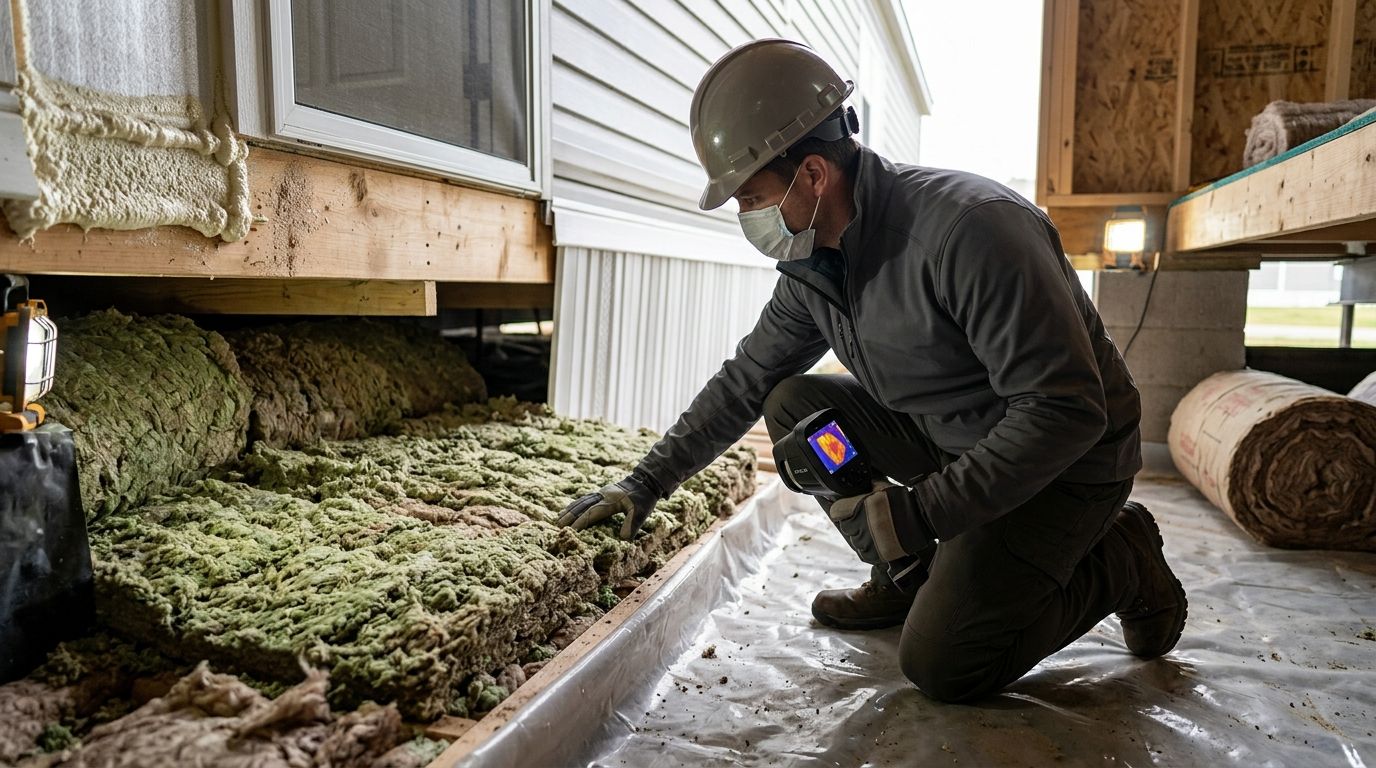
HUD-code manufactured homes are built lighter and tighter-budgeted than site-built houses, which means thinner wall cavities, minimal attic depth in some models, and a belly board that's the single biggest air-leak path in the entire structure. Crews at AT Foam see the same failure pattern across Seattle, Tacoma, and Olympia crawl spaces every winter: batt insulation sagging out of the belly wrap, moisture wicking up through unsealed vapor barriers, and heating bills that don't match the home's square footage.
The fix isn't always the same material for every part of the home. A 1998 single-wide with a torn belly board needs something different than a 2020 double-wide with an intact attic. That's why this ranking splits by use case instead of naming one universal winner.
Best overall: closed-cell spray foam. Best for attics and marriage walls: open-cell spray foam. Best budget option: fiberglass batt replacement.
What makes the best insulation for mobile homes
- Air sealing performance — gaps at the belly board and marriage wall matter more in manufactured homes than in stick-built houses
- Moisture resistance — crawl spaces under mobile homes trap ground moisture that rots batt insulation within a few years
- R-value per inch — cavity depth is often 2-4 inches less than a comparable site-built wall, so density counts
- Retrofit accessibility — can the material go in without gutting drywall or pulling skirting
- Longevity — batt and loose-fill degrade faster under a mobile home than in a conditioned attic
- Fit for HUD-code construction — thin marriage walls, shallow trusses, and non-standard framing rule out some products entirely
Insulation options at a glance
| Material | Best for | Standout feature | Key limitation |
|---|---|---|---|
| Closed-cell spray foam | Crawl space and belly board sealing | Air seals and vapor-blocks in one application | Higher upfront cost than batt or cellulose |
| Open-cell spray foam | Attics and marriage wall seams | Expands into odd HUD-code framing gaps | Not a vapor barrier on its own |
| Rigid foam board | Underbelly retrofits on skirted homes | DIY-installable in accessible crawl spaces | Seams need taping or they leak air |
| Fiberglass batt | Budget wall cavity replacement | Lowest material cost, widely available | Does nothing for air leaks, sags over time |
| Blown-in cellulose | Closed attic or wall upgrades | Installs without removing drywall | Settles over years, loses R-value |
1. Closed-cell spray foam: best insulation for mobile home crawl spaces
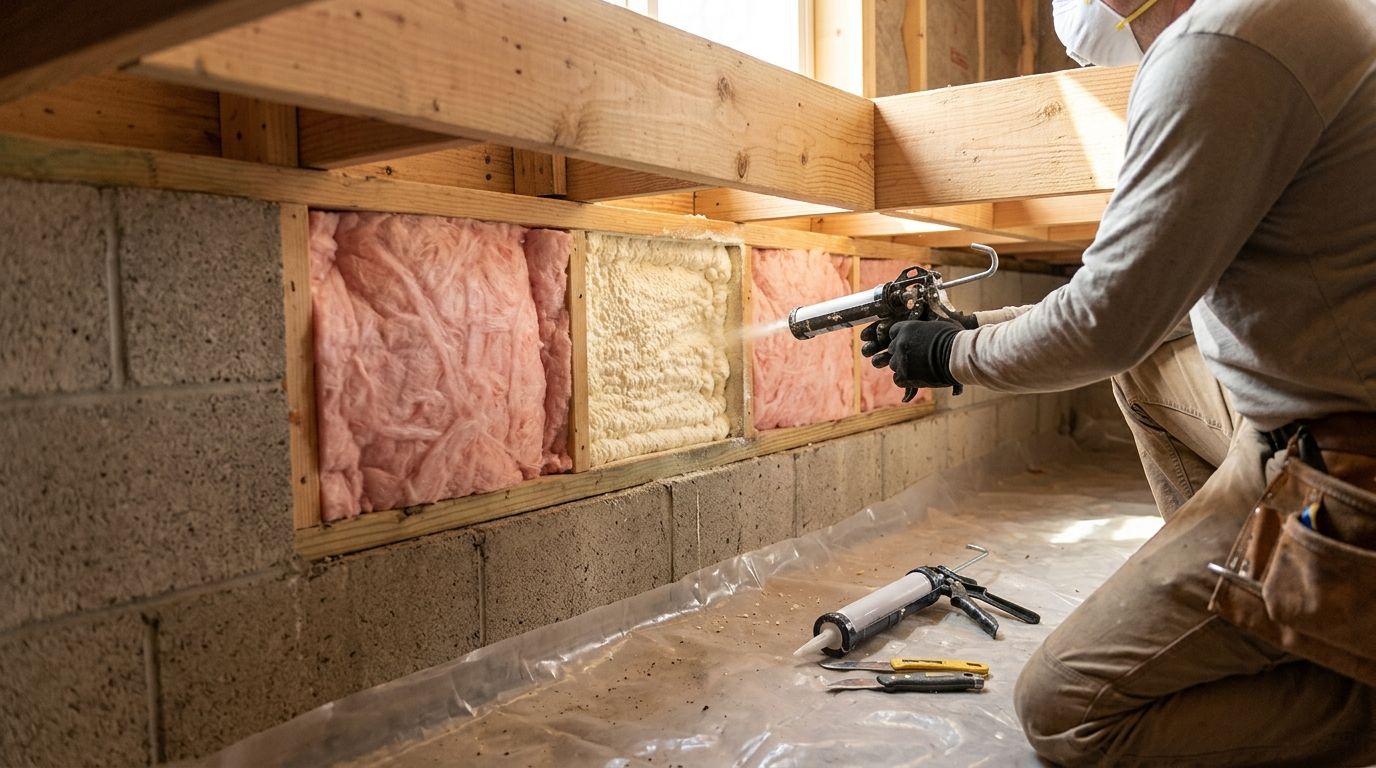
Closed-cell spray foam expands against the belly board, subfloor, and rim joists and cures into a rigid, water-resistant layer that also acts as an air barrier. In manufactured homes this matters because the belly board is usually the weakest point in the envelope — torn plastic sheeting, rodent damage, and gaps around plumbing penetrations all leak conditioned air straight into the ground.
Closed-cell spray foam pros:
- Doubles as a vapor barrier, which matters in Pacific Northwest crawl spaces with year-round ground moisture
- Higher R-value per inch than any other option on this list, useful where cavity depth is limited
- Adds structural rigidity to the belly board and subfloor
Closed-cell spray foam cons:
- Costs more upfront than batt or cellulose
- Requires professional application equipment — not a weekend DIY job
- Overkill for a dry, well-sealed attic with no moisture issues
Closed-cell spray foam pricing: get a site-specific quote since crawl space size and access vary widely.
Best for: manufactured homes with a damaged or missing belly board, or any crawl space with visible moisture. Verdict: Buy.
2. Open-cell spray foam: best insulation for mobile home attics and marriage walls
Open-cell spray foam expands more than closed-cell and fills irregular framing gaps, which makes it useful along marriage wall seams where two home sections meet — a spot that's notoriously hard to seal with batt insulation. It also cuts road noise and HVAC sound transfer better than fiberglass.
Open-cell spray foam pros:
- Expands fully into gaps and cavities that batt insulation can't reach
- Noticeably reduces sound transfer between rooms and from outside
- Lower material cost per board foot than closed-cell foam
Open-cell spray foam cons:
- Absorbs water if it gets wet, so it's the wrong call in a damp crawl space
- Lower R-value per inch than closed-cell
- Still needs a separate vapor barrier in some assemblies
Open-cell spray foam pricing: varies by attic size and access — request a quote before budgeting.
Best for: finished attics, marriage wall seams, and interior sound control. Verdict: Buy.
3. Rigid foam board: best insulation for mobile home underbelly retrofits
Rigid foam board — typically XPS or polyiso — gets cut to size and fastened directly to the underside of the belly board or between floor joists on skirted homes. It's the most DIY-accessible option here since it doesn't require spray equipment.
Rigid foam board pros:
- Straightforward to install with basic tools on an accessible crawl space
- Consistent R-value that doesn't sag or settle like batt insulation
- Available at most building supply stores
Rigid foam board cons:
- Seams and joints need to be taped or foamed, or the whole system leaks air
- Doesn't conform to irregular framing or plumbing penetrations the way spray foam does
- Labor-intensive for a full-length crawl space compared to spray application
Rigid foam board pricing: check current per-sheet pricing at a local supplier since it varies by thickness and R-value rating.
Best for: homeowners retrofitting an accessible underbelly themselves without hiring a spray crew. Verdict: Hold — solid option if you're doing the labor yourself, but factor in the seam-sealing step or you lose most of the benefit.
4. Fiberglass batt: best insulation for mobile home wall cavities on a budget
Fiberglass batt is what's already in most manufactured homes built before the mid-2000s, and it's still the cheapest way to replace insulation in an accessible wall cavity. It's not a bad material — it's just not built for air sealing, which is the actual weak point in most mobile homes.
Fiberglass batt pros:
- Lowest material cost of any option on this list
- Easy to source and install in standard-depth wall cavities
- No specialized equipment or crew required
Fiberglass batt cons:
- Provides zero air sealing on its own — drafts continue even with fresh batt installed
- Sags and compresses over time, especially in vertical wall cavities
- Loses most of its R-value when it gets damp, which is common in older mobile home walls
Fiberglass batt pricing: widely available at any home improvement store — compare current pricing locally.
Best for: a straight budget swap in dry, accessible wall cavities with no moisture history. Verdict: Hold — fine as a stopgap, weak as a long-term fix.
5. Blown-in cellulose: best insulation for mobile home attic upgrades without opening drywall
Blown-in cellulose gets pumped into existing wall cavities or attic spaces through small access holes, which makes it the only option here that doesn't require removing drywall or skirting. It's made from recycled paper fiber treated with fire retardant.
Blown-in cellulose pros:
- Installs through small access points without demolition
- Fills cavities more completely than batt, reducing gaps
- Reasonable R-value per inch for the installation method
Blown-in cellulose cons:
- Settles 15-20% over the years, gradually losing R-value at the top of wall cavities
- Absorbs moisture and can mold if the cavity isn't sealed against water intrusion
- Doesn't address air leaks at penetrations the way spray foam does
Blown-in cellulose pricing: get a quote based on square footage and cavity access — costs vary by how many access holes are needed.
Best for: upgrading an existing wall or attic cavity without tearing into the home. Verdict: Hold — good middle option when demolition isn't on the table.
Get a crawl space or attic quote
Free on-site assessment for manufactured and mobile homes in the Pacific Northwest.
How this list was ranked
Each material was scored against the six criteria above — air sealing, moisture resistance, R-value per inch, retrofit accessibility, longevity, and fit for HUD-code framing. Closed-cell spray foam and open-cell spray foam scored highest on air sealing and longevity, which is why they take the top two use-case slots. Fiberglass batt and blown-in cellulose scored lowest on air sealing specifically, which is the metric that drives most of the energy loss in a manufactured home.
If your crawl space smells damp or the belly board sags when you push on it, spray foam is the only material on this list that fixes both the moisture and the air leak in one job.
Which insulation should you choose?
If you're only fixing one thing in 2026, fix the belly board first — closed-cell spray foam is the best insulation for mobile homes with crawl space moisture or a damaged underbelly. If the crawl space is dry and the real problem is a drafty attic or noisy marriage wall, open-cell spray foam is the better fit. Everyone working with a tight budget and a dry, accessible wall cavity should default to fiberglass batt, understanding it won't stop drafts on its own.
FAQ
What is the best insulation for mobile homes in 2026?
Closed-cell spray foam is the best overall choice for mobile homes in 2026 because it seals air leaks and blocks moisture at the belly board in a single application. Open-cell spray foam is the better pick specifically for attics and marriage wall seams.
Is spray foam better than fiberglass for a mobile home?
Yes, for air sealing — fiberglass batt provides R-value but does nothing to stop drafts, while spray foam seals gaps and cavities at the same time. Fiberglass remains cheaper for a straight budget swap in dry, accessible cavities.
How do you insulate the belly board on a manufactured home?
Closed-cell spray foam applied directly to the belly board and subfloor is the standard fix, since it seals penetrations, resists moisture, and doesn't sag like batt insulation stuffed into a torn belly wrap.
Can you add insulation to a mobile home without removing the skirting?
Blown-in cellulose and spray foam applied through crawl space access panels both work without full skirting removal, depending on how much clearance the crew has underneath.
Does spray foam insulation stop moisture in a mobile home crawl space?
Closed-cell spray foam acts as a vapor barrier as well as an air seal, which is why it holds up better than fiberglass in a damp Pacific Northwest crawl space. Open-cell foam absorbs water and is the wrong choice in a moist crawl space.
What R-value do manufactured homes need?
Requirements vary by climate zone and HUD-code standard for the home's construction date, so check the rating on your home's data plate before choosing a material and thickness.
How long does spray foam insulation last in a mobile home?
Spray foam does not sag, settle, or compress the way batt and loose-fill insulation do, so it holds its R-value for the life of the home barring physical damage to the belly board or framing.
Is fiberglass batt insulation still worth using in 2026?
Fiberglass batt is still the cheapest option for a straight replacement in a dry, accessible wall cavity, but it does not address the air leaks that cause most of the energy loss in a manufactured home.
One last thing
Most manufactured home energy audits find the belly board, not the attic, as the single biggest source of heat loss — yet homeowners default to re-insulating the attic first because it's easier to access. Start underneath the home in 2026, not overhead, and the rest of the insulation upgrade gets a lot less urgent.