Converting a Seattle garage into living space comes down to one material decision that affects comfort, moisture control, and your energy bill for decades. Best overall for a garage conversion: closed-cell spray foam. Best for interior partition walls: open-cell spray foam. Best budget option: rigid foam board. Fiberglass batts and blown-in cellulose round out the list, but both carry trade-offs that matter more in a wet Pacific Northwest climate than in a drier region.
- Closed-cell spray foam is the best insulation for garage conversion projects in Seattle because it air-seals and vapor-seals in one pass at R-6 to R-7 per inch.
- Open-cell spray foam runs R-3.5 to R-3.6 per inch and fits interior partition walls where sound control matters more than moisture control.
- Rigid foam board (XPS or polyiso) is the practical add-on for garage doors and slab edges, not full wall cavities.
- Fiberglass batts cost the least upfront but trap moisture in an unheated Western Washington garage shell and lose R-value when compressed.
- 2026 building codes push conditioned garage conversions toward higher wall and ceiling R-values than a standard uninsulated garage.
Why this matters
A garage is not built like the rest of your house. It usually sits at grade, shares a slab with the driveway, and was never meant to hold conditioned air. Converting it into a bedroom, office, or ADU in 2026 means the wall and ceiling assembly has to do two jobs it never did before: stop air movement and stop moisture from a slab or stem wall that sees rain nine months a year in Seattle, Tacoma, and Olympia.
Get that wrong and you get a converted garage that's cold in January, sticky in July, and smells musty by 2027. AT Foam sees this most often in older garages where the original framing was never designed for a finished interior — the fix has to address air sealing and vapor control together, not just fill the stud bay.
What makes the best insulation for garage conversions
- Air-sealing performance — blocks drafts at rim joists, top plates, and the garage door header, not just the open stud bay
- Moisture and vapor control — critical where a garage slab sits close to grade in a wet climate
- R-value per inch — most garage stud bays are 2x4, so limited depth has to work harder
- Code fit for conditioned space — a converted garage has to meet the same energy code as the rest of the house
- Sound dampening — matters most on the partition wall between the converted space and the rest of the home
- Ease of retrofit — whether the wall is open framing or already finished with drywall
Garage conversion insulation at a glance
| Insulation type | Best for | Standout feature | Key limitation |
|---|---|---|---|
| Closed-cell spray foam | Full conversions needing air + vapor seal | R-6 to R-7 per inch, adds structural rigidity | Higher material cost per board foot |
| Open-cell spray foam | Interior partition walls, sound control | Expands into irregular framing, dampens noise | Vapor-permeable, needs a separate retarder on exterior walls |
| Rigid foam board (XPS/polyiso) | Garage doors, slab edges, rim joists | Consistent R-5 to R-6 per inch, cuts to exact size | Seams need taping or sealant or they leak air |
| Fiberglass batts | Budget-only stud-bay fill | Lowest material cost, easy DIY install | No air seal; loses R-value when compressed or damp |
| Blown-in cellulose | Retrofitting finished stud cavities | Fills around existing wiring without demo | Settles over years, moisture-sensitive |
1. Closed-cell spray foam: best insulation for garage conversion needing a single-step air and vapor seal
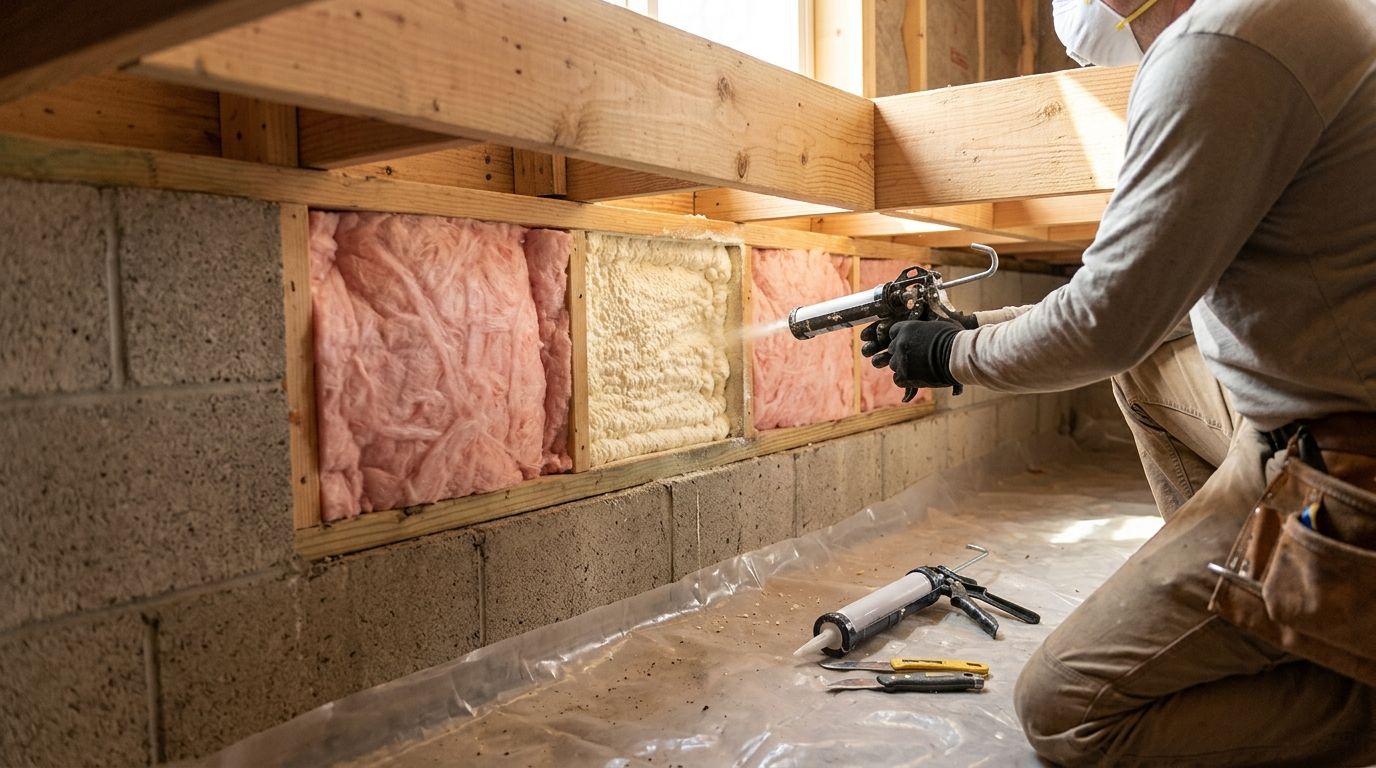
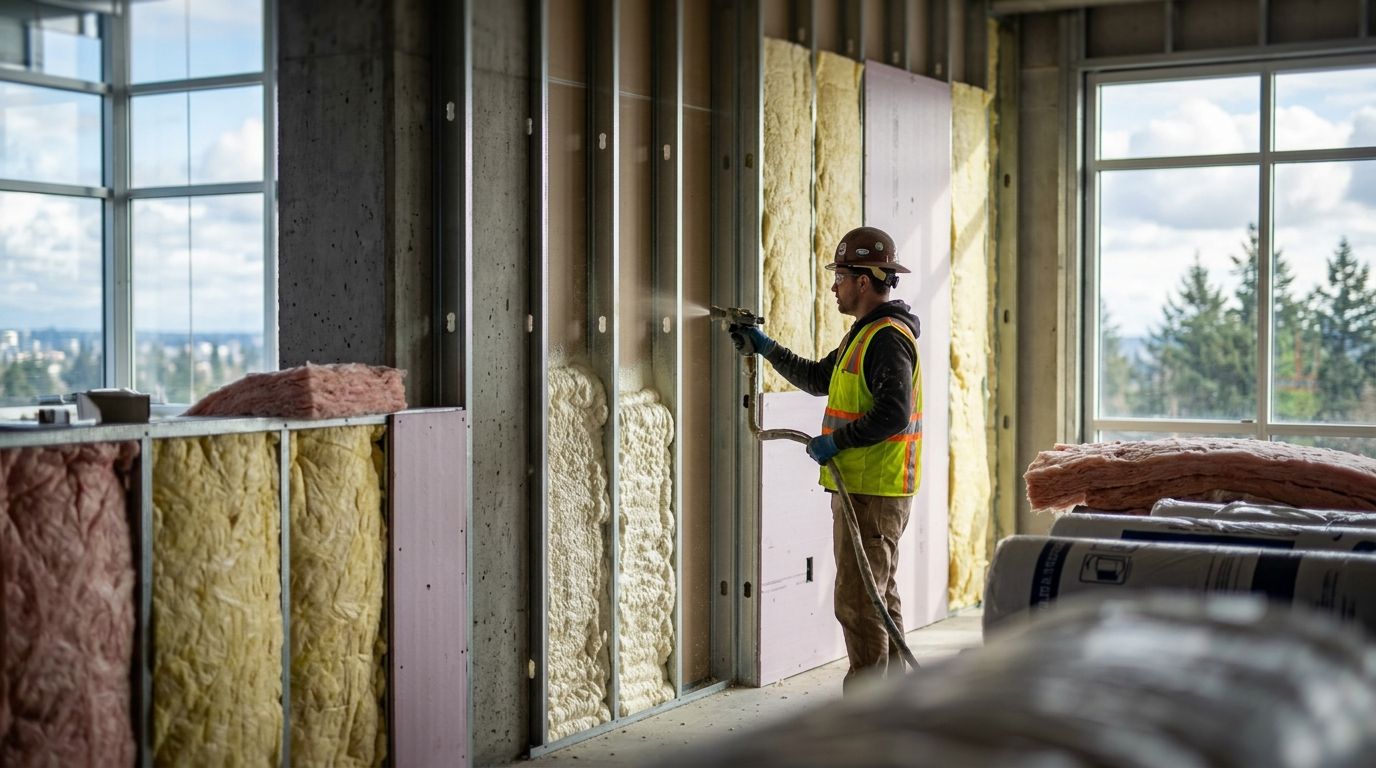
Closed-cell spray foam expands to roughly 30-40 times its liquid volume, filling every gap in a stud bay, rim joist, or garage door header in one application. It builds R-6 to R-7 per inch, so a standard 2x4 wall cavity reaches R-21 or higher without adding cavity depth. It also functions as its own vapor retarder, which matters where a garage slab and stem wall pull ground moisture year-round.
Closed-cell spray foam pros:
- Air-seals and vapor-seals in the same pass, no separate vapor barrier needed
- Highest R-value per inch on this list
- Adds rigidity to stud walls and rim joists, useful in older garages with racked framing
- Resists moisture wicking through the wet season
Closed-cell spray foam cons:
- Costs more per board foot than fiberglass or open-cell
- Requires a licensed applicator, not a weekend DIY project
- Once cured, running new wiring or plumbing through the cavity gets harder
Best for: full garage-to-living-space conversions that will be heated year-round. Closed-cell spray foam verdict: Buy.
2. Open-cell spray foam: best for interior partition walls and sound control
Open-cell spray foam also expands on contact but stays soft and vapor-permeable, landing around R-3.5 to R-3.6 per inch. It's the right call on interior partition walls between a converted garage and the rest of the house, where blocking sound matters more than blocking vapor. The soft, spongy fill measurably drops airborne noise transfer between rooms.
Open-cell spray foam pros:
- Fills irregular framing and odd angles better than batts or board
- Noticeably reduces sound transfer through interior partition walls
- Lower material cost than closed-cell for the same square footage
- Still delivers a continuous air seal, unlike batts
Open-cell spray foam cons:
- Vapor-permeable, so exterior-facing walls need a separate vapor retarder
- Lower R-value per inch means deeper cavities are needed to match closed-cell totals
- Wrong call for below-grade or moisture-prone sections of a garage
Best for: interior partition walls and sound dampening between the converted garage and adjoining rooms. Open-cell spray foam verdict: Buy.
3. Rigid foam board (XPS/polyiso): best for garage doors, slab edges, and rim joists
Rigid foam board comes as extruded polystyrene (XPS, roughly R-5 per inch) or polyisocyanurate (polyiso, roughly R-6 per inch) sheets cut to size and fastened or glued in place. It's the standard pick for a garage door panel, rim joists, and slab edges where a spray application isn't practical. Sheets stack in thin-cavity spots for extra R-value.
Rigid foam board pros:
- Consistent, predictable R-value per inch on the spec sheet
- Cuts to exact dimensions for garage doors and slab-edge details
- No cure time, no odor, installs same day
- Works as a DIY add-on around a professionally spray-foamed shell
Rigid foam board cons:
- Seams and edges need tape or canned foam or they leak air
- Doesn't conform to irregular framing the way spray foam does
- Covering full wall cavities with board alone is labor-intensive compared to spray
Best for: garage doors, slab edges, and rim joists rather than full wall cavities. Rigid foam board verdict: Buy — as a supplement, not a stand-alone system.
4. Fiberglass batts: best for budget-only stud-bay fill
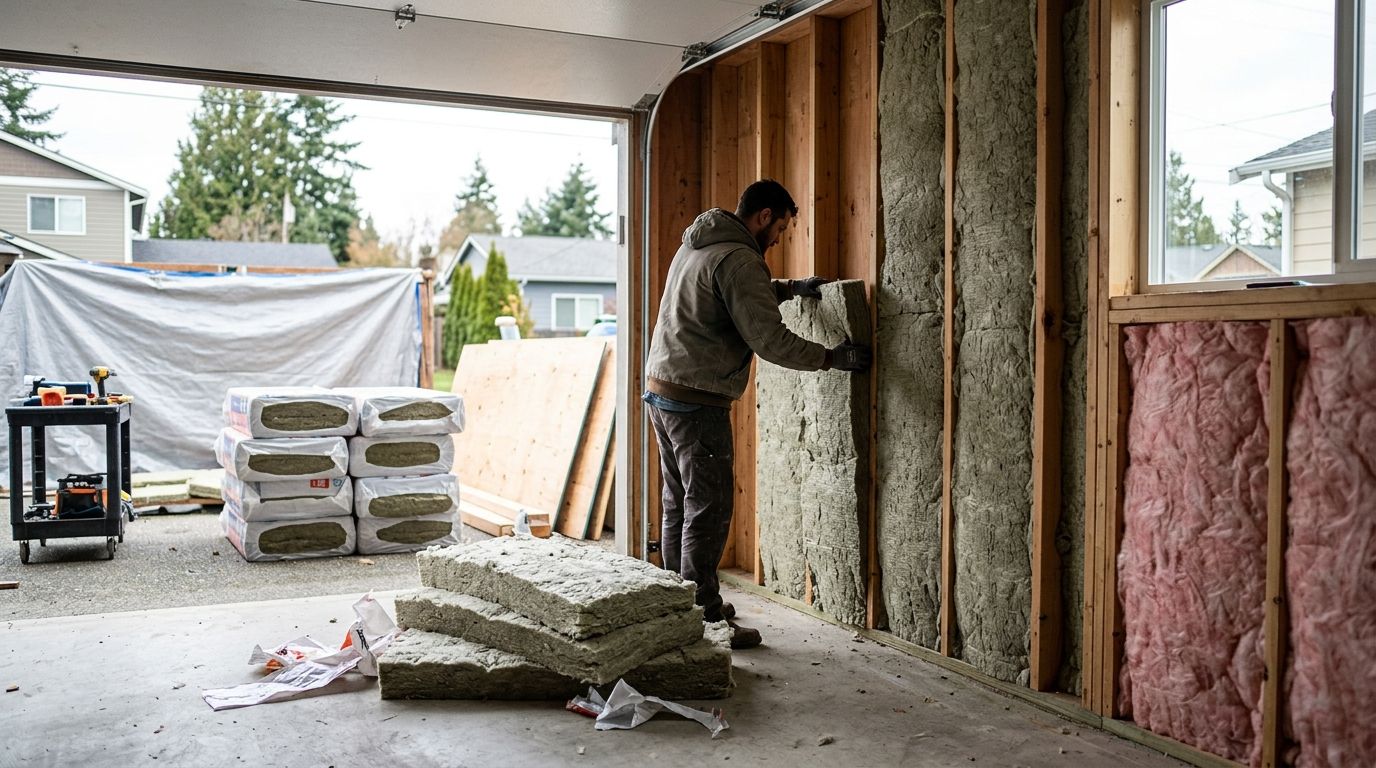
Fiberglass batts are pre-cut rolls that friction-fit between studs, rated around R-3.1 to R-3.4 per inch depending on density. They're the cheapest material on this list and the easiest to install without a contractor. In a converted garage in Western Washington, though, batts do nothing to stop air movement through the same stud bay they fill.
Fiberglass batts pros:
- Lowest material cost of any option here
- Widely available at any hardware store in the Seattle area
- Simple enough for a DIY install in an afternoon
- No cure time or off-gassing
Fiberglass batts cons:
- Zero air-sealing value; drafts move through and around the batt
- Loses R-value fast when compressed, gapped, or damp — common in an unheated garage shell before conversion
- Absorbs moisture and can support mold growth if the garage sees any water intrusion
Best for: interior stud bays on a strict budget where air sealing is handled separately. Fiberglass batts verdict: Skip for a full conversion; hold as a last resort for non-critical bays only.
5. Blown-in cellulose: best for retrofitting finished stud cavities
Blown-in cellulose gets dense-packed into closed stud cavities through small drilled holes, landing around R-3.2 to R-3.8 per inch. It's the practical choice when garage walls are already finished with drywall and tearing them open for spray foam isn't in the budget. Installers drill, fill, and patch, leaving the wall surface mostly intact.
Blown-in cellulose pros:
- Installs without demolishing finished walls
- Fills around wiring and plumbing already in the cavity
- Denser pack than batts, so it resists settling better than loose-fill fiberglass
Blown-in cellulose cons:
- Still vapor-permeable and moisture-sensitive if the garage has bulk water issues
- Settles a small amount over years, thinning coverage at the top of the cavity
- No air-sealing at penetrations unless paired with separate sealant work
Best for: retrofitting an already-finished garage wall without opening it up. Blown-in cellulose verdict: Hold — use only when opening the wall for spray foam isn't an option.
How we ranked
Every material on this list got weighed against the same six criteria: air-sealing performance, R-value per inch, moisture behavior in a Puget Sound climate, fit with 2026 code requirements for conditioned space, sound control at partition walls, and how disruptive the install is to an already-framed or already-finished garage.
“If the garage wall sits within a few feet of grade, the insulation has to stop moisture and air at the same time — one without the other is a callback waiting to happen.”
Which insulation should you choose for a Seattle garage conversion?
For a full conversion where the garage becomes a bedroom, office, or ADU, closed-cell spray foam is the default pick — it handles air sealing and vapor control in one application and hits the highest R-value per inch available for a shallow 2x4 cavity. Use open-cell spray foam on interior partition walls where sound control matters more than moisture, and reach for rigid foam board on the garage door, rim joists, and slab edge as a supplement. Fiberglass batts and blown-in cellulose stay on the list for budget-constrained or already-finished walls, but neither replaces an air-sealed, vapor-controlled shell in a Western Washington garage.
Get a garage conversion quote
Free estimate for spray foam insulation in Seattle, Tacoma, and Olympia.
FAQ
What's the best insulation for a garage conversion in Seattle?
Closed-cell spray foam is the best insulation for garage conversion projects in Seattle because it air-seals and vapor-seals a stud cavity in one application at R-6 to R-7 per inch. It also resists moisture wicking through the wet season, which matters for a garage slab sitting near grade.
Is spray foam better than fiberglass for a garage conversion?
Yes, for a full conversion. Fiberglass batts fill the stud bay but do nothing to stop air movement, while spray foam air-seals as it expands, which matters more in a converted space that needs to hold conditioned air year-round.
Can I use fiberglass batts in a garage conversion?
Fiberglass batts work for a strict-budget stud-bay fill but lose R-value when compressed or damp, a real risk in an unheated garage shell before conversion. Pair batts with a separate air-sealing step if budget rules out spray foam.
Do I need open-cell or closed-cell spray foam for a garage?
Use closed-cell on exterior-facing walls and the garage envelope where moisture control matters, and open-cell on interior partition walls where sound dampening is the priority. Open-cell is vapor-permeable, so it needs a separate vapor retarder on exterior walls.
How much R-value do I need for a garage conversion in 2026?
A converted garage that becomes conditioned living space needs to meet the same wall and ceiling R-value targets as the rest of the house under 2026 energy code, which is higher than a standard uninsulated garage. Closed-cell spray foam reaches those targets in a shallow 2x4 cavity where batts often can't.
Is rigid foam board enough insulation for a garage door?
Rigid foam board at R-5 to R-6 per inch works well cut to fit garage door panels, but seams need taping or sealant to stop air leaks around the edges. It's a supplement for the door, rim joists, and slab edge rather than a full-wall insulation system.
Does blown-in cellulose work for a garage conversion?
Blown-in cellulose is a solid retrofit option when garage walls are already finished with drywall and opening them for spray foam isn't practical. It settles slightly over years and stays moisture-sensitive, so it works best as a fallback rather than a first choice.
What insulation stops moisture in a Seattle garage?
Closed-cell spray foam acts as its own vapor retarder while air-sealing the cavity, which is the combination that matters most where a garage slab and stem wall sit close to grade in a wet Pacific Northwest climate.
One last thing
The detail most homeowners miss on a garage conversion isn't the wall insulation — it's the rim joist and the garage door header, two spots where air leaks the hardest and batts physically can't seal. A spray foam pass on just those two areas, paired with rigid foam board on the door panel, closes most of the draft path even before the rest of the wall gets touched. Skip that step and the rest of the insulation upgrade underperforms no matter what material fills the stud bay.