Closed-cell spray foam wins overall for new home construction in Washington in 2026, open-cell spray foam wins for attic and wall air sealing on a tighter budget, and fiberglass batt wins as the lowest-cost code-compliant option for stick-built walls.
- Closed-cell spray foam is the best insulation for new construction in Washington when moisture control and structural rigidity matter, especially in crawl spaces and rim joists.
- Open-cell spray foam wins for full attic and wall air sealing at a lower installed cost than closed-cell foam.
- Fiberglass batt is the cheapest way to hit Washington's 2026 energy code minimums but leaks the most air of any option here.
- Blown-in cellulose covers open attic floors fast and uses recycled material, but it settles over time.
- Rigid foam board solves thermal bridging on exterior walls but needs a separate air-sealing layer to perform.
Why this matters for a 2026 build in Washington
Washington's energy code keeps tightening, and most of Western Washington sits in a marine climate zone where moisture, not just cold, drives insulation failures. Pick the wrong material in a crawl space or rim joist and you're looking at mold and rot within a few winters, not decades.
AT Foam installs both open-cell and closed-cell spray foam across Seattle, Tacoma, and Olympia new-construction jobs, and the pattern is consistent: builders who mix materials by zone (foam where moisture risk is high, batt or blown-in where it isn't) get better performance per dollar than builders who pick one material for the whole house.
This guide ranks the five insulation types builders and homeowners actually use in new Washington construction in 2026, tells you where each one wins, and where it falls short.
What makes the best insulation for new construction in Washington
- R-value per inch — how much thermal resistance you get per inch of cavity depth, which matters more in 2x4 walls than 2x6
- Air sealing performance — batts and loose-fill leave gaps; spray foam and rigid board close them
- Moisture and vapor control — critical in crawl spaces, rim joists, and below-grade walls in a wet climate
- Code compliance margin — how easily the material clears Washington's current prescriptive R-value targets
- Installed cost profile relative to lifetime performance — not the sticker price, but cost against decades of air sealing and moisture protection
- Long-term stability — whether the material settles, sags, or degrades after installation
Insulation types at a glance
| Insulation type | Best for | Standout feature | Key limitation |
|---|---|---|---|
| Closed-cell spray foam | Crawl spaces and rim joists | Vapor-closed, adds structural rigidity | Higher material cost per board foot |
| Open-cell spray foam | Full attic and wall air sealing | Expands to fill irregular cavities completely | Vapor-open, needs a vapor strategy in wet zones |
| Fiberglass batt | Budget-driven stick-built walls | Lowest cost path to code minimums | Weak air sealing, easy to install poorly |
| Blown-in cellulose | Open attic floors | Fast coverage, recycled content | Settles 15-20% over time, reducing R-value |
| Rigid foam board | Exterior continuous insulation | Cuts thermal bridging through studs | Needs separate air sealing and joint taping |
1. Closed-cell spray foam: best insulation for crawl spaces and rim joists
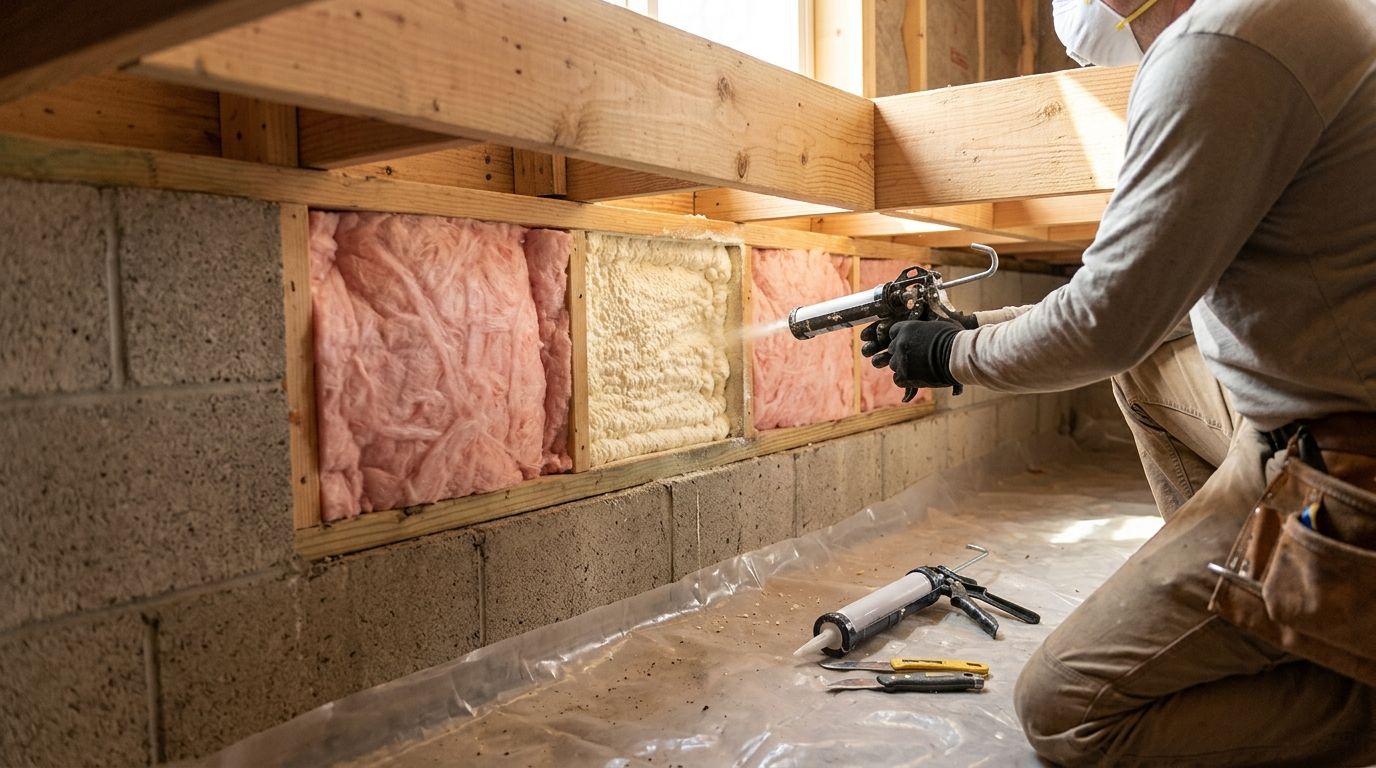
Closed-cell spray foam runs roughly R-6 to R-7 per inch, making it the highest R-value-per-inch option on this list. It cures rigid, adds racking strength to the assembly it's sprayed into, and blocks vapor drive, which is why it's the standard pick for Washington crawl spaces and rim joist cavities where ground moisture and condensation risk are constant.
Closed-cell spray foam pros:
- Highest R-value per inch of any material here
- Doubles as a vapor barrier, critical in Pacific Northwest crawl spaces
- Adds structural stiffness to floor and wall assemblies
- Doesn't sag, settle, or lose R-value over time
Closed-cell spray foam cons:
- Costs more per board foot than any other option on this list
- Requires a trained crew for even coverage — a bad spray job wastes material
- Not ideal for large open attic floors where budget per square foot matters more
Best for: crawl spaces, rim joists, below-grade walls, and any cavity where moisture control matters as much as R-value.
Verdict: Buy for moisture-prone assemblies in new Washington construction.
2. Open-cell spray foam: best for attic and wall air sealing
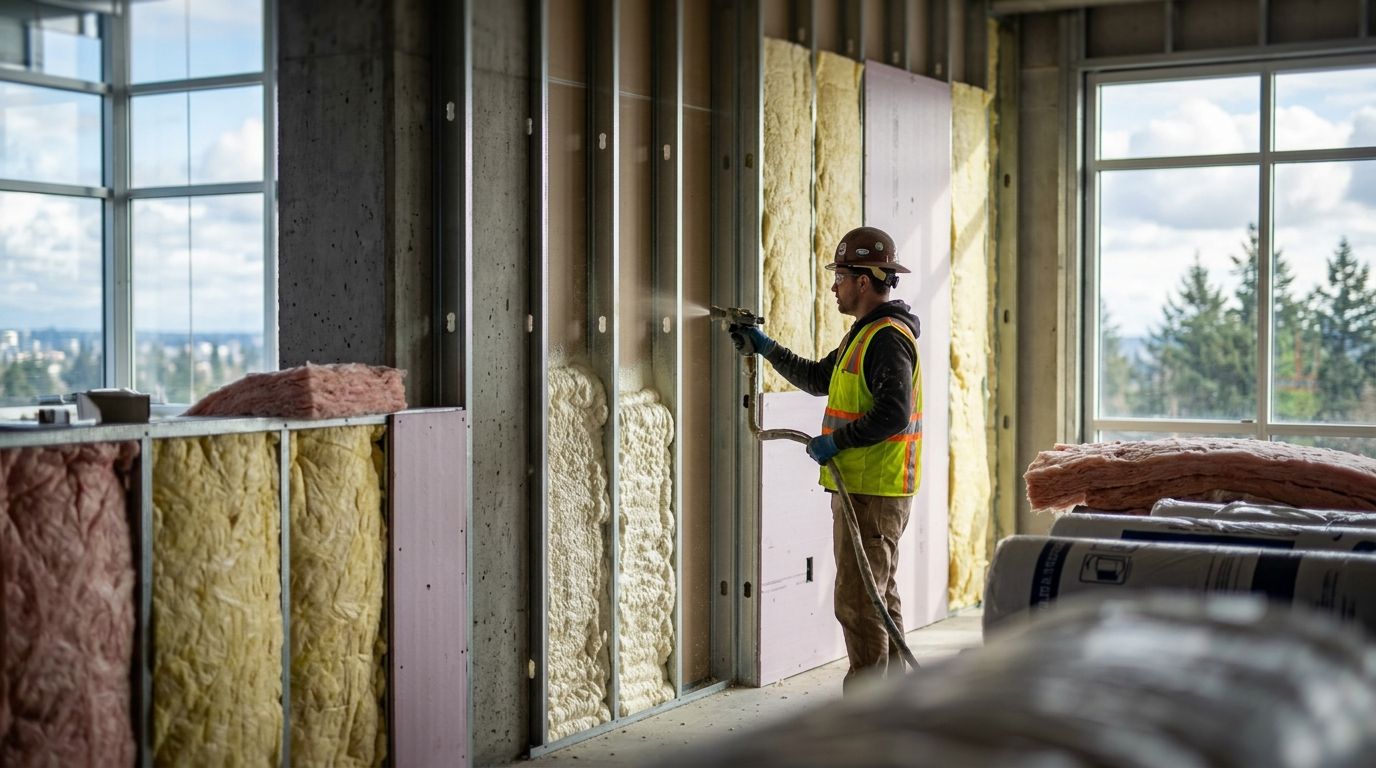
Open-cell spray foam runs around R-3.5 to R-3.8 per inch — lower than closed-cell, but it expands more per unit of material, which lets it fill irregular attic and wall cavities completely at a lower installed cost than closed-cell foam. It also cuts airborne sound transfer between rooms, a detail builders underrate until a homeowner complains post-move-in.
Open-cell spray foam pros:
- Air-seals cavities completely, unlike batt or loose-fill
- Costs less installed than closed-cell foam for the same square footage
- Reduces sound transfer between floors and rooms
- Expands into irregular framing gaps that batts can't fill
Open-cell spray foam cons:
- Vapor-open, so it needs a deliberate vapor strategy in wet-climate assemblies
- Lower R-value per inch means deeper cavities are needed to hit code minimums
- Not the right call for below-grade or ground-contact applications
Best for: full attic decks and above-grade interior walls where air sealing matters more than vapor control.
Verdict: Buy for attics and above-grade walls in new Washington builds.
3. Fiberglass batt: best budget option for code-minimum walls
Fiberglass batt runs about R-3.1 to R-3.4 per inch and remains the cheapest way to hit Washington's prescriptive wall R-value targets in a standard stick-built home. It's fast to install and widely available, which is why production builders default to it on tract construction.
Fiberglass batt pros:
- Lowest material cost of any option on this list
- Widely stocked, no specialty crew required
- Straightforward to inspect during framing walkthrough
Fiberglass batt cons:
- Weakest air sealing performance — gaps around outlets, top plates, and penetrations go unsealed
- Compresses easily during installation, cutting real-world R-value below the rated number
- Does nothing for moisture control in damp assemblies
Best for: interior partition walls and budget-constrained new builds where code compliance, not performance, is the target.
Verdict: Hold — fine for interior walls, weak as the only strategy in exterior assemblies.
4. Blown-in cellulose: best for open attic floors
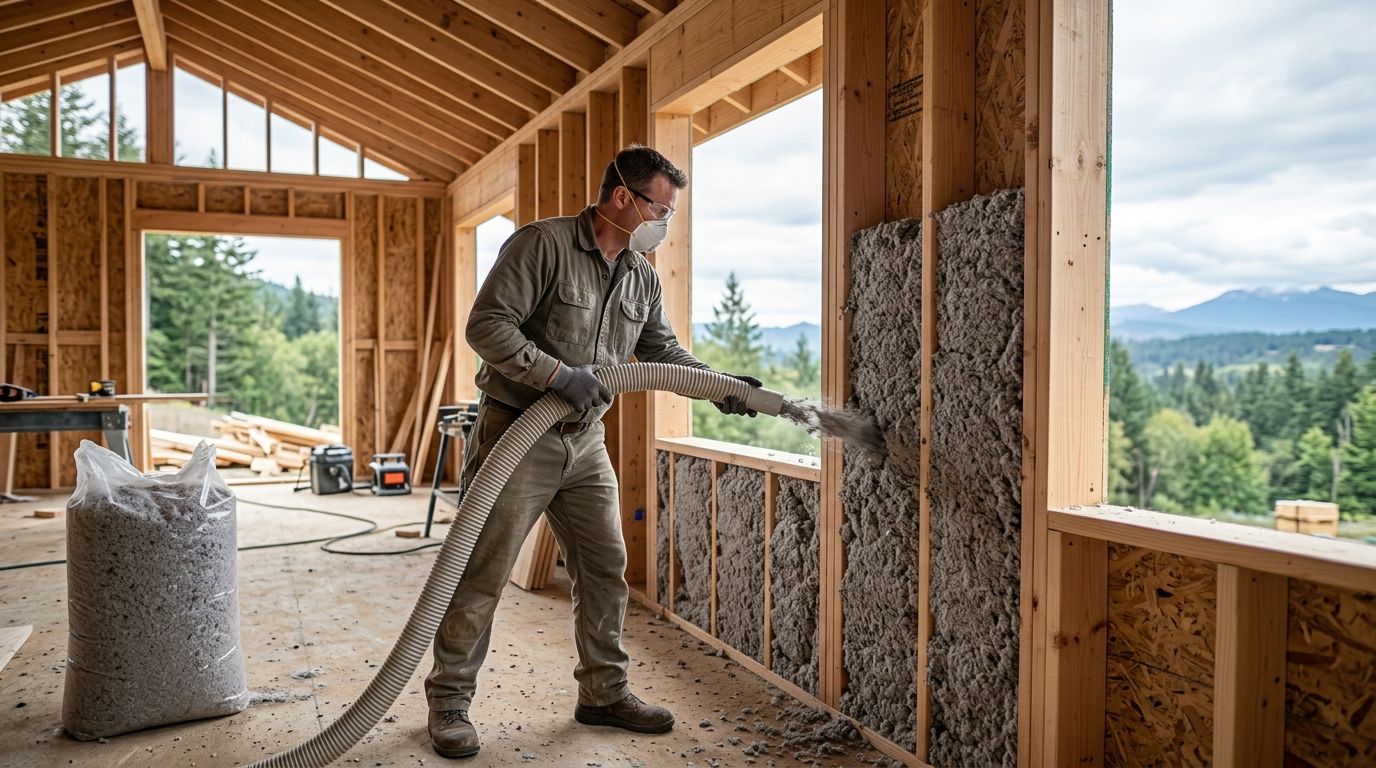
Blown-in cellulose delivers roughly R-3.2 to R-3.8 per inch and covers large, open attic floors faster than batt installation. It's made from recycled paper fiber treated with fire retardant, which appeals to builders marketing sustainability features in 2026.
Blown-in cellulose pros:
- Fast coverage over large, unobstructed attic floors
- Fills around joists and wiring better than batt
- Recycled material content
Blown-in cellulose cons:
- Settles 15-20% over the first few years, reducing effective R-value
- Absorbs moisture if a roof leak or condensation issue develops
- Not suitable for vertical wall cavities without netting
Best for: open, unfinished attic floors in new construction where speed and coverage matter more than long-term stability.
Verdict: Hold — good attic-floor option, but plan for settling in the R-value math.
5. Rigid foam board: best for exterior continuous insulation
Rigid foam board (XPS or polyiso) runs R-4 to R-6.5 per inch depending on the type and wraps the exterior of the frame, cutting the thermal bridging that happens every 16 inches through a stud. It's the material most new-construction energy models lean on to hit whole-wall R-value targets without adding cavity depth.
Rigid foam board pros:
- Eliminates thermal bridging through studs, a gap every other material on this list has
- High R-value per inch for exterior sheathing applications
- Pairs well with any cavity insulation choice above
Rigid foam board cons:
- Needs taped seams and separate air sealing to actually perform as rated
- Adds a labor step most production builders skip unless code requires it
- Doesn't solve cavity insulation on its own — it's a supplement, not a standalone system
Best for: exterior wall sheathing on new builds targeting above-code thermal performance.
Verdict: Buy as a supplement to cavity insulation, not a replacement for it.
How this ranking was built
Each material was scored against the six criteria above: R-value per inch, air sealing, moisture control, code compliance margin, cost-to-performance, and long-term stability. Closed-cell and open-cell spray foam scored highest on air sealing and moisture control, the two factors that cause the most callback issues in Washington's wet climate. Batt and cellulose scored well on cost but lag on air sealing, and rigid board scored highest on thermal bridging but requires pairing with a cavity material.
Which insulation should you choose for a 2026 Washington build?
If you're building anywhere from Seattle to Olympia and want one answer: closed-cell spray foam in crawl spaces and rim joists, open-cell spray foam in the attic and above-grade walls. That combination handles the moisture load a marine climate throws at a house while air-sealing the assembly completely. If budget forces a tradeoff on interior partition walls, fiberglass batt is an acceptable fallback there — just don't let it carry the exterior envelope alone.
“Pick insulation by where moisture goes in the assembly, not by what's cheapest per square foot.”
Get a free spray foam quote
AT Foam sprays open-cell and closed-cell foam on new builds across Seattle, Tacoma, and Olympia.
FAQ
What is the best insulation for new construction in Washington in 2026?
Closed-cell spray foam is the best overall choice for crawl spaces and rim joists, and open-cell spray foam wins for full attic and wall air sealing. Fiberglass batt works as a budget fallback on interior partition walls only.
Is spray foam better than fiberglass for a new build?
Spray foam air-seals completely and outperforms fiberglass on moisture control, which matters more in Washington's marine climate than in drier regions. Fiberglass costs less but leaks more air around penetrations and top plates.
Does new construction in Washington require spray foam?
No single material is mandated by code, but Washington's prescriptive R-value targets for walls and attics push many builders toward foam or continuous rigid board to hit the numbers without oversized cavities.
How much R-value do you need for a new home in Washington?
Washington's energy code sets attic and wall R-value minimums that vary by assembly type and climate zone, with attics typically needing the highest R-value target in the code. A licensed insulation contractor can confirm the exact requirement for your specific build.
Does closed-cell spray foam work in a crawl space?
Yes, closed-cell spray foam is the standard choice for Washington crawl spaces because it blocks vapor drive from ground moisture while adding rigidity to the floor assembly above it.
Does blown-in cellulose settle over time?
Yes, cellulose typically settles 15-20% after installation, which lowers its effective R-value in an open attic floor. That settling should be factored into the initial depth calculation.
Can you mix insulation types in one new construction build?
Yes, and it's often the better approach — closed-cell foam in moisture-prone crawl spaces, open-cell foam in the attic, and batt on interior partitions is a common combination in new Washington builds.
Is rigid foam board enough insulation on its own?
No, rigid foam board reduces thermal bridging through studs but needs a cavity insulation material behind it and taped seams for air sealing to hit full performance.
One last thing
The detail most new-construction plans miss in 2026 isn't the insulation material — it's the rim joist. It's a small strip of the envelope, but it's one of the highest air-leakage points in a typical Washington home, and it's exactly where closed-cell spray foam earns its cost over batt or loose-fill.