Washington's building code (WSEC 2021, still the enforced baseline through 2026) pushes commercial projects toward higher R-values and tighter air sealing than most contractors quote for by default — picking the wrong insulation type on a Tacoma warehouse or a Seattle office retrofit means paying for compliance twice.
- Closed-cell spray foam insulation wins for below-grade and moisture-prone commercial spaces in Washington's wet climate.
- Open-cell spray foam insulation is the best commercial insulation option for interior sound control and air sealing in conditioned buildings.
- Mineral wool batt is the pick for fire-rated partition walls in multi-tenant commercial buildings.
- Blown-in fiberglass stays the budget option for large, open, uncomplicated attic runs.
- Rigid foam board handles continuous exterior insulation on commercial retrofit walls best.
Why this matters
Most commercial insulation decisions in Washington get made on price per square foot alone, and that number ignores moisture, air leakage, and fire code — three things the Pacific Northwest climate punishes hard. A crawl space under a Kent restaurant with fiberglass batts will grow mold within a season if it floods once; the same space with closed-cell spray foam doesn't care. Picking the right material for the actual use case, not the cheapest one on the shelf, is what separates a 20-year insulation job from a 5-year callback.
The verdict
Best overall for Washington commercial buildings: closed-cell spray foam insulation. Best for interior air sealing and noise control: open-cell spray foam insulation. Best for fire-rated partition walls: mineral wool batt. Best budget option for large open attics: blown-in fiberglass. Best for continuous exterior retrofits: rigid foam board.
What makes the best commercial insulation for Washington
- R-value per inch — how much thermal resistance you get per dollar of wall or attic depth, which matters more in commercial buildings with tight cavity space
- Moisture and vapor resistance — critical in a state where crawl spaces flood and roofs see 150+ days of rain a year
- Air sealing capacity — commercial HVAC systems fight leaks constantly; a material that seals gaps cuts load on the equipment
- Fire rating — code-driven for multi-tenant and mixed-use buildings, non-negotiable on partition walls
- Installation disruption — how much downtime a business absorbs during the retrofit
- Long-term stability — whether the material sags, settles, or degrades with moisture exposure over 10-20 years
Commercial insulation options at a glance
| Insulation Type | Best For | Standout Feature | Key Limitation |
|---|---|---|---|
| Closed-cell spray foam | Crawl spaces, below-grade, moisture-heavy areas | ~R-6.5 per inch, doubles as a vapor barrier | Higher material cost per board foot |
| Open-cell spray foam | Interior walls, attics, sound dampening | Expands to fill gaps, cuts airborne noise | Not a vapor barrier on its own |
| Mineral wool batt | Fire-rated partition walls | Naturally fire-resistant, holds shape | Lower R-value per inch than spray foam |
| Blown-in fiberglass | Large open attics, budget retrofits | Fast installation over big areas | Settles over time, air leaks persist |
| Rigid foam board | Exterior continuous insulation | Consistent R-value, no thermal bridging | Requires taped seams to seal properly |
1. Closed-cell spray foam: best commercial insulation for moisture-prone spaces
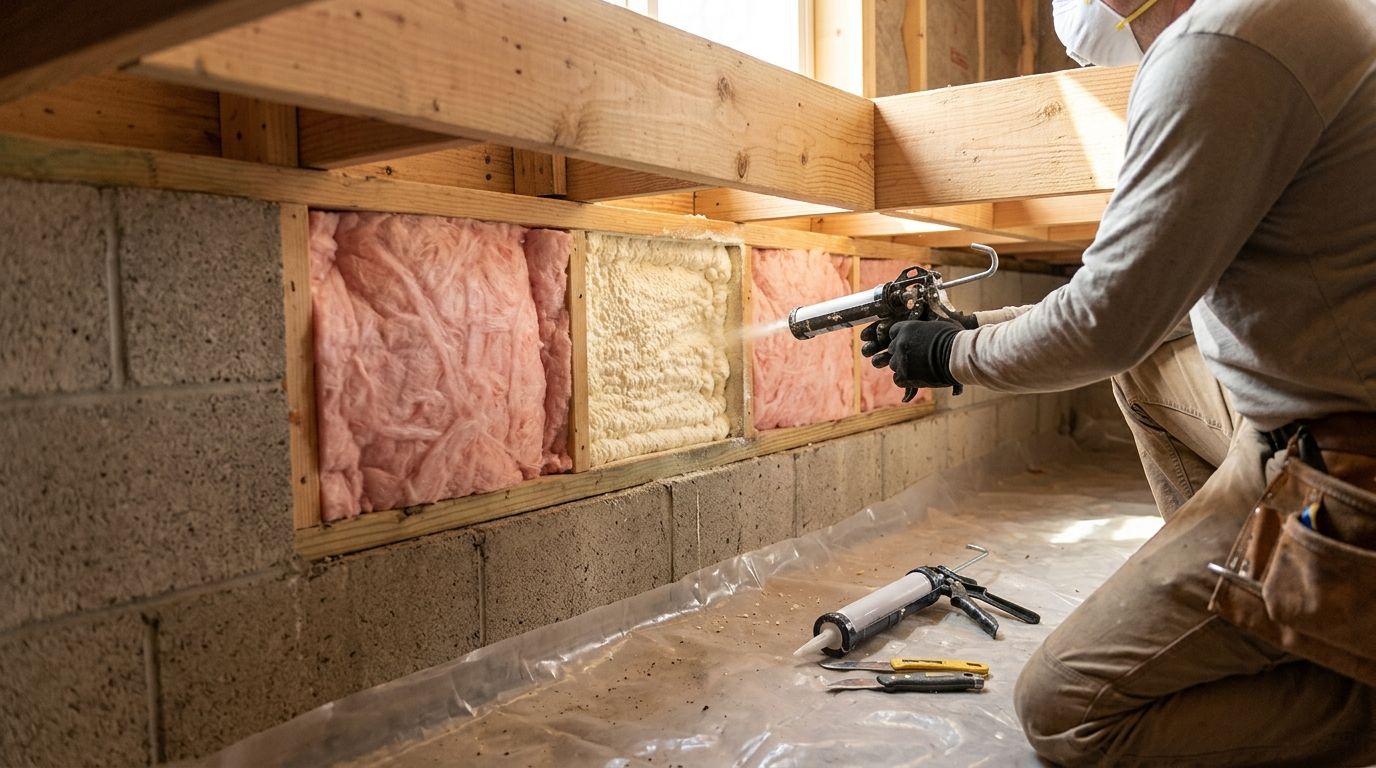
Closed-cell spray foam insulation runs around R-6.5 per inch, the highest of any option on this list, and it forms a rigid, water-resistant layer as it cures. In Washington's wet-side climate, that combination matters most in crawl spaces, below-grade mechanical rooms, and any commercial structure near grade where groundwater is a recurring problem.
Closed-cell spray foam pros:
- Acts as its own vapor barrier — no separate poly sheeting needed
- Adds structural rigidity to the assembly it's sprayed into
- Highest R-value per inch means thinner cavities still hit code minimums
- Resists mold growth even after intermittent moisture exposure
Closed-cell spray foam cons:
- Costs more per board foot than open-cell or batt options
- Requires a trained crew — a bad spray job leaves voids that are hard to inspect after cure
- Not the right call for large open attic runs where budget matters more than moisture control
Best for: crawl spaces, basements, and any commercial space with recurring moisture exposure. Verdict: Buy.
2. Open-cell spray foam: best commercial insulation for interior air sealing and sound control
Open-cell spray foam expands more than closed-cell during application, filling irregular gaps around wiring, ductwork, and framing that batt insulation simply can't reach. At roughly R-3.7 per inch, it trades some thermal performance for superior air sealing and noticeable sound dampening between floors or tenant spaces.
Open-cell spray foam pros:
- Fills irregular cavities completely, cutting air leakage at the source
- Reduces airborne noise transfer between commercial units or floors
- Lower material cost than closed-cell for the same square footage
- Expands to reach tight framing without gaps
Open-cell spray foam cons:
- Lower R-value per inch means thicker cavities are needed to hit the same target
- Absorbs moisture if exposed to a leak, so it's a poor fit below grade
- Still needs a separate air barrier in some assemblies depending on code review
Best for: interior walls, conditioned attics, and multi-tenant buildings where noise control matters as much as thermal performance. Verdict: Buy.
3. Mineral wool batt: best commercial insulation for fire-rated partition walls
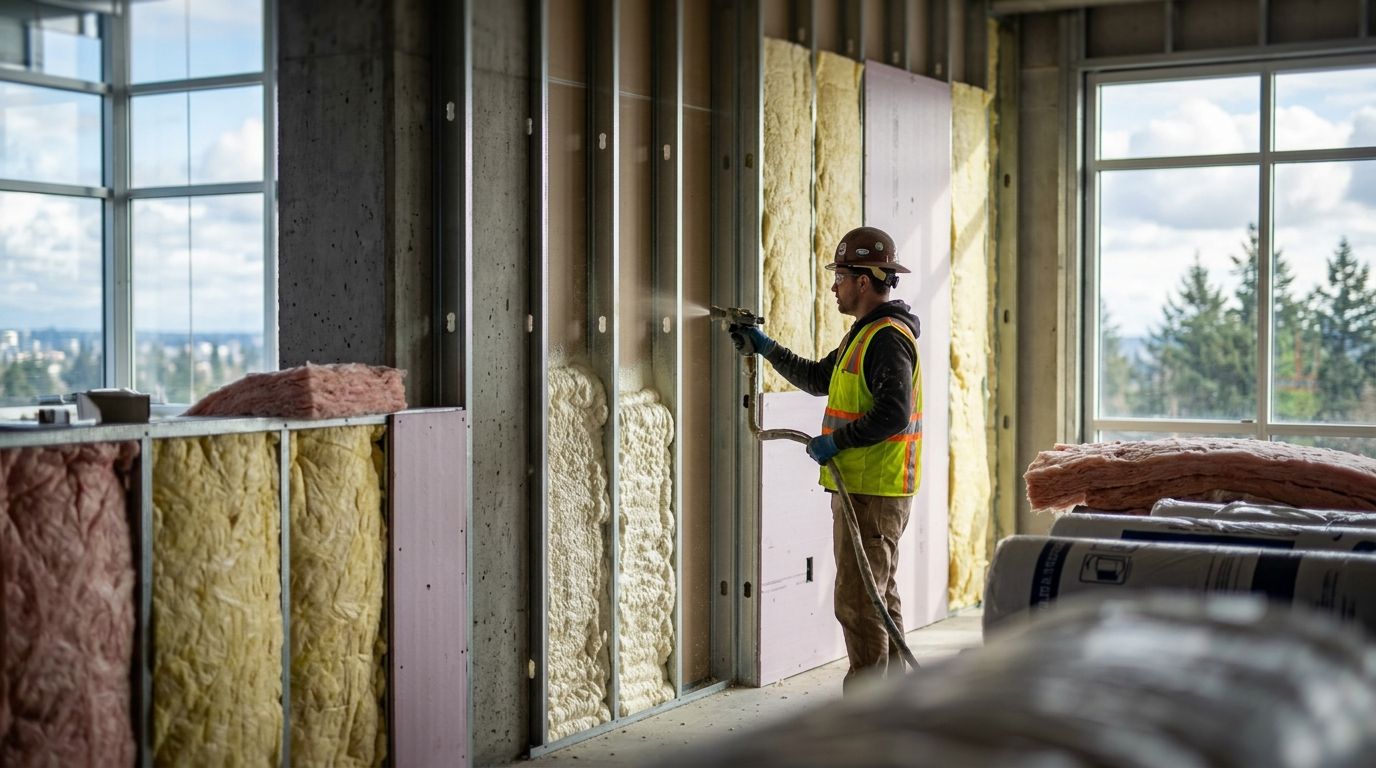
Mineral wool batt insulation is the standard pick when a commercial partition wall needs to meet a fire-rated assembly requirement. It's naturally non-combustible, holds its shape without sagging over decades, and lands around R-4.2 per inch, ahead of standard fiberglass but behind either spray foam type.
Mineral wool pros:
- Naturally fire-resistant, which simplifies meeting fire-rated wall assembly requirements
- Doesn't sag or settle inside the cavity over time
- Handles moisture exposure better than fiberglass without losing R-value
- Cuts sound transmission well in multi-tenant walls
Mineral wool cons:
- Lower R-value per inch than either spray foam option
- Doesn't seal air gaps the way spray foam does — batts still leave seams
- Installation is more labor-intensive per square foot than blown-in options
Best for: fire-rated partition walls in multi-tenant commercial buildings. Verdict: Hold — use it where code requires a fire rating, not as a general-purpose thermal upgrade.
4. Blown-in fiberglass: best budget commercial insulation for large open attics
Blown-in fiberglass covers large, open, uncomplicated attic spaces fast, which is why it stays the budget default on big commercial roof decks with few penetrations. R-value runs R-2.2 to R-2.7 per inch depending on density, the lowest on this list, so it needs more depth to hit the same target as spray foam.
Blown-in fiberglass pros:
- Fastest installation method for large open attic areas
- Lowest material cost per square foot among the five options
- No cure time — the space is usable again almost immediately
Blown-in fiberglass cons:
- Settles over years, losing effective R-value if not topped off
- Does nothing to seal air leaks around ductwork, wiring, or framing gaps
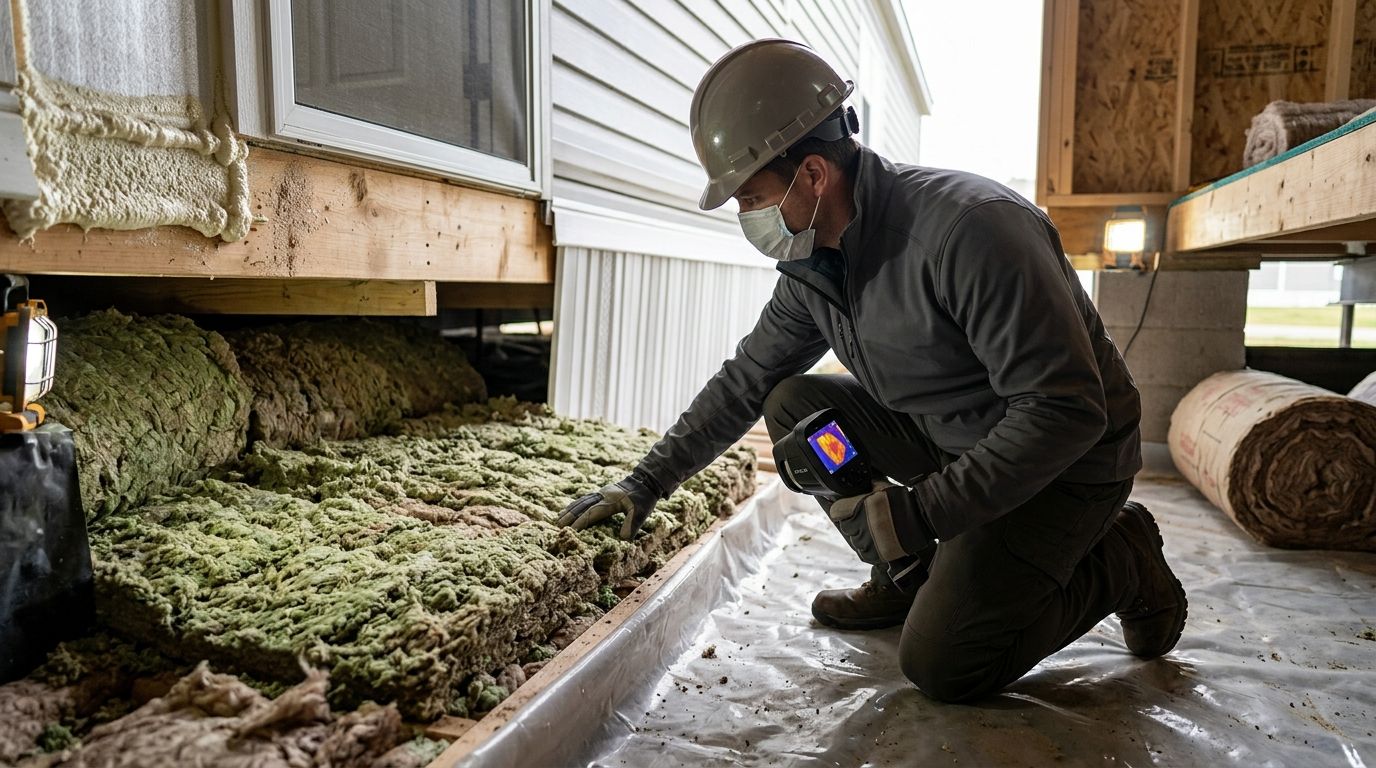
- Performs poorly if it ever gets wet — it doesn't dry out or recover R-value
Best for: large, open commercial attics with a fixed budget and no moisture concerns. Verdict: Hold — fine for the right space, wrong choice near any leak risk.
5. Rigid foam board: best for exterior continuous insulation retrofits
Rigid foam board — XPS or polyiso — gets used on the exterior of commercial walls during a retrofit to add continuous insulation without opening up interior finishes. Polyiso runs close to R-6 per inch, XPS closer to R-5 per inch, both ahead of fiberglass batt but requiring careful seam taping to actually perform at rated value.
Rigid foam board pros:
- Adds continuous insulation with no thermal bridging through studs
- Doesn't require interior disruption — installs on the exterior face
- Consistent, predictable R-value across the whole panel
Rigid foam board cons:
- Seams must be taped and sealed correctly or air leakage undercuts the R-value
- Adds thickness to the exterior wall assembly, which can affect trim and flashing details
- Doesn't address interior air sealing or existing cavity gaps
Best for: commercial exterior retrofits where interior operations can't be disrupted. Verdict: Buy — for exterior work specifically, not as a substitute for cavity insulation.
How we ranked these
Each type got scored against the six criteria above — R-value per inch, moisture resistance, air sealing, fire rating, installation disruption, and long-term stability — then matched to the commercial use case where it scores highest instead of forcing every option into one leaderboard. That's why closed-cell spray foam insulation and mineral wool batt aren't competing for the same slot: one solves a moisture problem, the other solves a fire code requirement, and a Washington commercial building often needs both in different parts of the same structure.
Get a free commercial insulation quote
Veteran-owned crews serving Seattle, Tacoma, and Olympia.
Which commercial insulation should you choose?
For most Washington commercial buildings in 2026, the honest default is a mix: closed-cell spray foam insulation in crawl spaces and below-grade areas, open-cell spray foam insulation in conditioned interior walls and attics, and mineral wool batt anywhere code demands a fire rating. Blown-in fiberglass and rigid foam board earn their spots on budget-driven attic jobs and exterior retrofits, respectively, but they're the exception, not the default, once moisture or fire code enters the picture. Checking real installed pricing for your building type is worth doing before committing — the spray foam insulation cost breakdown for Seattle covers what actually drives the number up or down.
FAQ
What is the best commercial insulation for Washington state?
Closed-cell spray foam insulation is the best overall choice for Washington commercial buildings because it resists the moisture common in crawl spaces and below-grade areas while hitting the highest R-value per inch of any common option in 2026.
Is spray foam better than fiberglass for commercial buildings?
Spray foam insulation seals air leaks and resists moisture better than fiberglass, but fiberglass costs less and installs faster over large open attic areas, so the right pick depends on whether moisture or budget is the bigger concern.
Does commercial insulation in Washington need to meet a fire rating?
Multi-tenant and mixed-use commercial buildings in Washington often require fire-rated wall assemblies at partition walls, which is where mineral wool batt is typically specified over spray foam or fiberglass.
How much R-value does commercial spray foam add per inch?
Closed-cell spray foam adds roughly R-6.5 per inch, while open-cell spray foam adds roughly R-3.7 per inch, both ahead of standard fiberglass batt at R-3.1 to R-3.4 per inch.
Can rigid foam board replace spray foam in a commercial retrofit?
Rigid foam board works well as continuous exterior insulation on a retrofit but doesn't seal interior air leaks the way spray foam does, so most projects use it alongside cavity insulation rather than instead of it.
Is blown-in fiberglass a good long-term option for commercial attics?
Blown-in fiberglass works for large open attics on a budget but settles over time and loses R-value, so it needs periodic top-offs to keep performing at its rated level.
How do I find a spray foam insulation contractor in Seattle or Tacoma?
Look for a licensed, insured crew with commercial experience and real job-site references rather than stock photography, since spray foam quality depends entirely on correct application depth and mix ratio.
One last thing
The biggest mistake on Washington commercial jobs isn't picking the wrong insulation type — it's picking one type for the whole building. A warehouse with a below-grade loading dock, a conditioned office wing, and a fire-rated tenant partition needs three different materials in three different zones, and a contractor who quotes one blanket solution across all of them is cutting corners somewhere. Before signing off on a bid for 2026, ask which material goes where and why — a real answer names the zone, not just the square footage.