
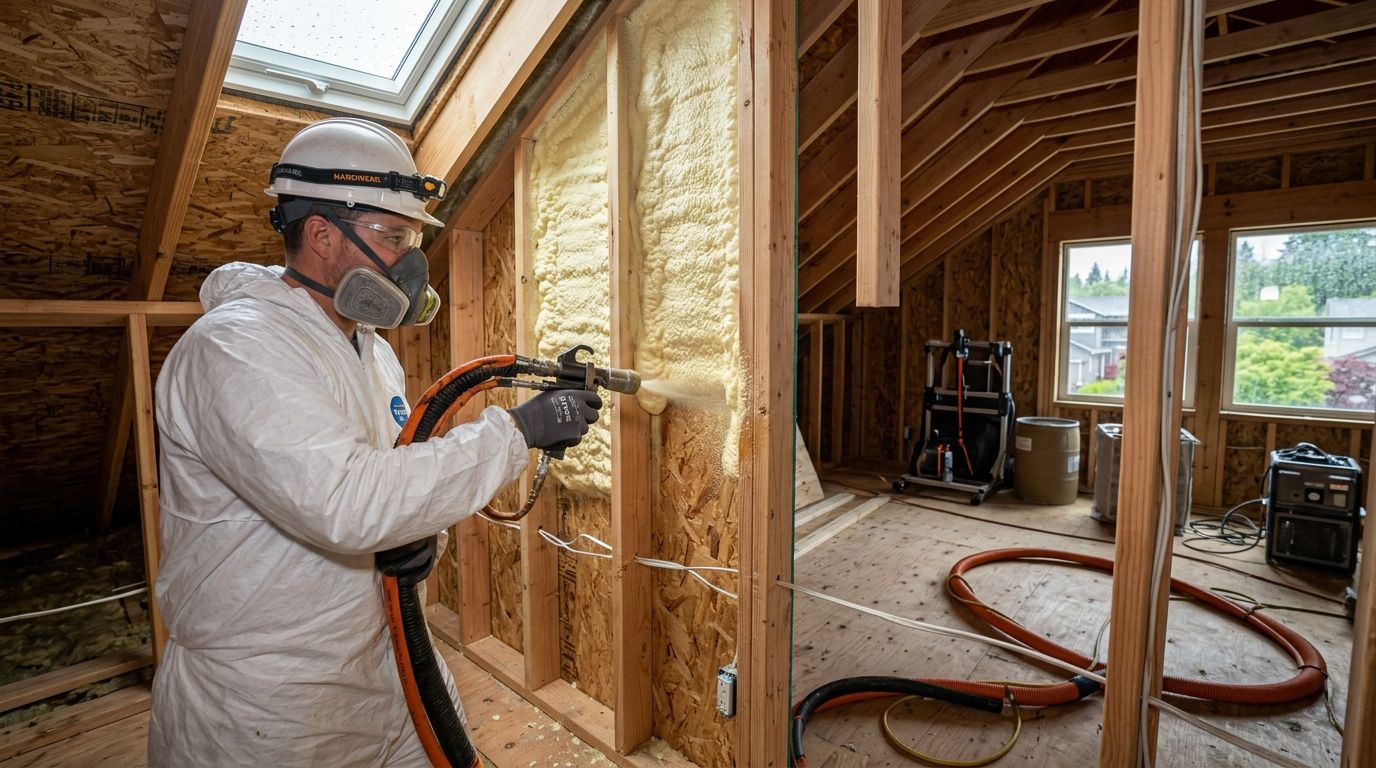
Spray foam insulation costs about $2,500 for a typical Seattle attic or crawl space job in 2026, with total project costs ranging from $1,500 to $4,500 depending on square footage and foam type. Removal of old fiberglass or cellulose, attic baffles, and permit fees are the hidden costs that push a bid above the per-square-foot rate quoted on the phone.
- Spray foam insulation in Seattle runs $1.50 to $5.50 per square foot installed in 2026, depending on open-cell or closed-cell foam.
- A typical attic or crawl space job totals $1,500 to $4,500; whole-house wall jobs cost more.
- Closed-cell foam costs roughly double open-cell but delivers R-6 to R-7 per inch versus R-3.5 to R-3.6 for open-cell.
- Old insulation removal, baffle installs, and permit fees are the line items that push bids above the headline rate.
- AT Foam Insulation prices attic and crawl space jobs by square footage and access, not a flat per-house number.
Why spray foam insulation cost matters in Seattle
Seattle's wet, mild climate punishes homes with gaps and thermal bridging more than it punishes homes with low R-values alone. Moisture control matters as much as heat retention here, which is why closed-cell foam shows up so often in Pacific Northwest crawl space bids even though it costs more per square foot than open-cell.
Homeowners in Tacoma and Olympia see the same pricing structure as Seattle proper. Labor and material costs track regionally, so a 1,200-square-foot attic in South Sound costs about the same as one in North Seattle, assuming similar access and foam type.
How much does spray foam insulation cost in Seattle?
Here's how the two main foam types and a traditional alternative compare on price, R-value, and moisture performance:
| Insulation type | Cost per sq ft installed | R-value per inch | Best for |
|---|---|---|---|
| Open-cell spray foam | $1.50 - $3.00 | R-3.5 to R-3.6 | Attics, interior walls, sound dampening |
| Closed-cell spray foam | $3.00 - $5.50 | R-6 to R-7 | Crawl spaces, rim joists, moisture-prone areas |
| Fiberglass batts | $0.50 - $1.50 | R-2.9 to R-3.8 | Budget attic retrofits, no air-sealing need |
Verdict: closed-cell spray foam wins for Seattle-area crawl spaces because it resists ground moisture, while open-cell is the better value for attic floors that don't sit near standing water. AT Foam Insulation prices both by square footage during a free on-site estimate rather than quoting a flat number over the phone.
Open-cell spray foam: $1.50 to $3.00 per square foot
Open-cell foam expands to fill irregular attic framing and air-seals as it cures, which is why it often replaces fiberglass batts in older Seattle homes with leaky top plates. It runs cheaper than closed-cell because it uses less material per inch of coverage, but it absorbs water if it gets wet, so it's a poor fit for below-grade crawl spaces. Best for: attic floors and interior wall cavities. Buy.
Closed-cell spray foam: $3.00 to $5.50 per square foot
Closed-cell foam is denser, adds structural rigidity to rim joists, and shrugs off the ground moisture common in Pacific Northwest crawl spaces. The higher R-value per inch means a thinner application hits code, which sometimes offsets part of the higher per-square-foot price on tight crawl space jobs. Best for: crawl spaces, rim joists, and any area exposed to moisture. Buy for wet or below-grade spaces.
Why spray foam insulation cost varies
- Square footage — larger attics and crawl spaces cost more in total but often see a lower per-square-foot rate.
- Foam type — closed-cell runs roughly double open-cell per square foot in 2026.
- Old insulation removal — pulling out existing fiberglass or vermiculite before spraying adds labor hours.
- Access — cramped crawl spaces under 24 inches of clearance take longer to spray, which adds to labor cost.
- Permits — some Washington municipalities require a permit for insulation work, adding a fixed fee to the total.
- Home age — pre-1980s homes in Seattle and Tacoma often need baffle installation or knob-and-tube clearance work before foam goes in.
Get a spray foam quote in Seattle
Free on-site estimate for attic, crawl space, or wall jobs.
Is spray foam insulation worth the cost in Seattle?
Spray foam insulation is worth the cost for Seattle homeowners dealing with drafty attics, cold floors over crawl spaces, or high heating bills tied to air leakage rather than low R-value alone. The air-sealing effect of both open-cell and closed-cell foam cuts drafts that batts and blown-in insulation can't stop on their own.
How much does it cost to insulate a crawl space in Tacoma or Olympia?
Crawl space insulation with closed-cell spray foam typically costs $2,000 to $4,000 in Tacoma and Olympia in 2026, tracking close to Seattle pricing since labor and material costs are regional. Moisture-prone crawl spaces sometimes need vapor barrier work added to the same bid, which increases the total.
Does spray foam insulation increase home value?
Spray foam insulation doesn't have a single published resale-value figure, but it does reduce documented energy loss compared to uninsulated or under-insulated attics and crawl spaces, which buyers and inspectors both notice during a sale. Improved comfort and lower utility bills are the selling points that show up in listing descriptions more than a specific dollar return.
FAQ
How much does spray foam insulation cost in Seattle in 2026?
Spray foam insulation costs $1.50 to $5.50 per square foot installed in Seattle in 2026, with a typical attic or crawl space job totaling $1,500 to $4,500. Closed-cell foam runs roughly double open-cell per square foot.
What's the difference between open-cell and closed-cell spray foam?
Open-cell spray foam delivers R-3.5 to R-3.6 per inch and costs $1.50 to $3.00 per square foot, while closed-cell delivers R-6 to R-7 per inch and costs $3.00 to $5.50 per square foot. Closed-cell also resists moisture better, which matters in Pacific Northwest crawl spaces.
Is closed-cell or open-cell better for a crawl space?
Closed-cell spray foam is better for crawl spaces because it resists ground moisture, while open-cell absorbs water and can break down in damp, below-grade spaces. Seattle-area crawl spaces almost always call for closed-cell foam.
How much does spray foam insulation cost per square foot?
Spray foam insulation costs $1.50 to $3.00 per square foot for open-cell and $3.00 to $5.50 per square foot for closed-cell in 2026. The final price depends on square footage, access, and whether old insulation needs removal first.
Does spray foam insulation cost more than fiberglass?
Yes, spray foam costs more than fiberglass batts, which run $0.50 to $1.50 per square foot compared to $1.50 to $5.50 for spray foam. The tradeoff is air-sealing performance that fiberglass batts don't provide on their own.
How much does crawl space insulation cost in Washington state?
Crawl space insulation with closed-cell spray foam costs $2,000 to $4,000 in the greater Seattle, Tacoma, and Olympia area in 2026. Vapor barrier work or moisture remediation can add to that total.
Is spray foam insulation a good investment in 2026?
Spray foam insulation is a good investment in 2026 for homes with documented air leakage or moisture issues in the attic or crawl space, since it air-seals as it cures and reduces the drafts that drive up heating bills. Homes with newer, well-sealed envelopes see less benefit from the switch.
One last thing
Many Seattle-area homes built before the 1980s have zero insulation in the crawl space, not just under-insulation, which means the $2,000 to $4,000 closed-cell range often includes work that has never been done rather than a simple upgrade. Ask any contractor bidding a crawl space job in 2026 whether the quote assumes bare ground or an existing vapor barrier, because that single detail changes the total more than foam type does.