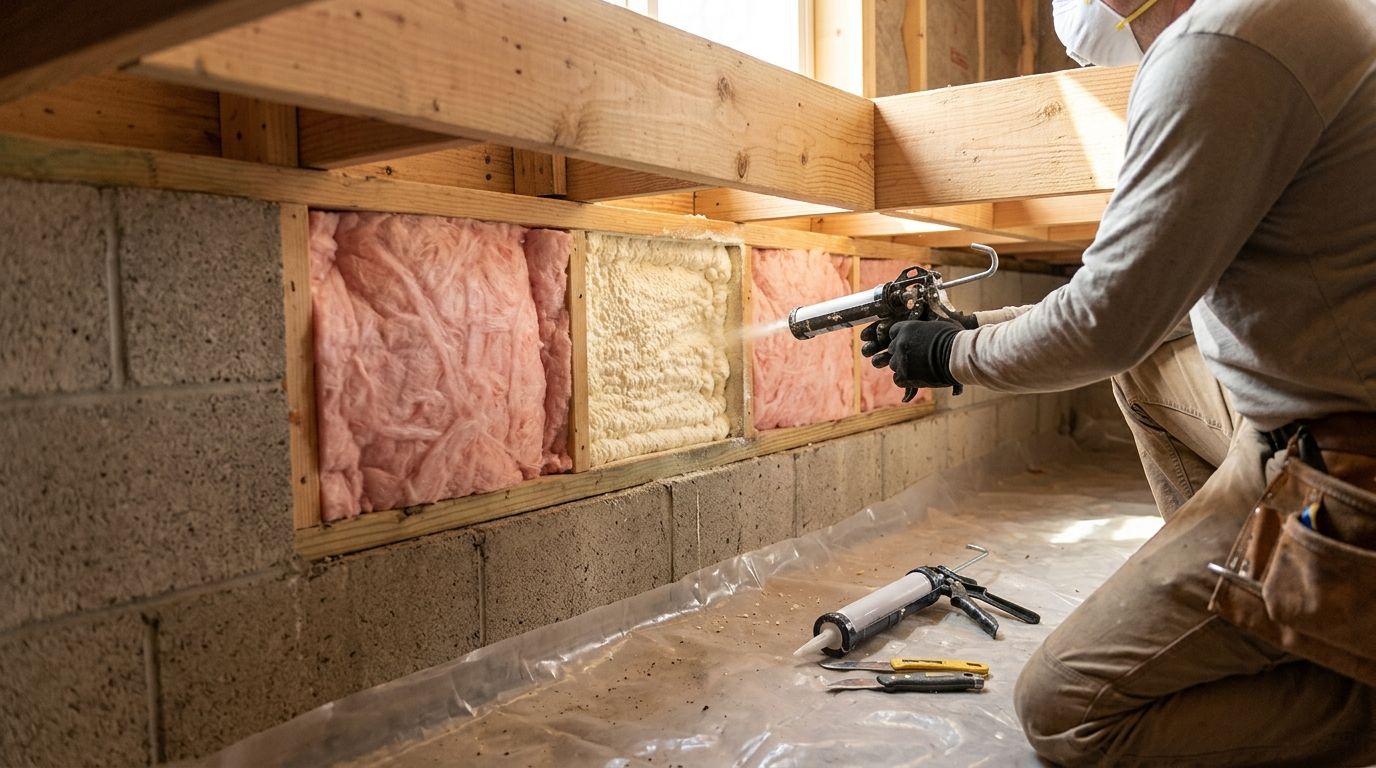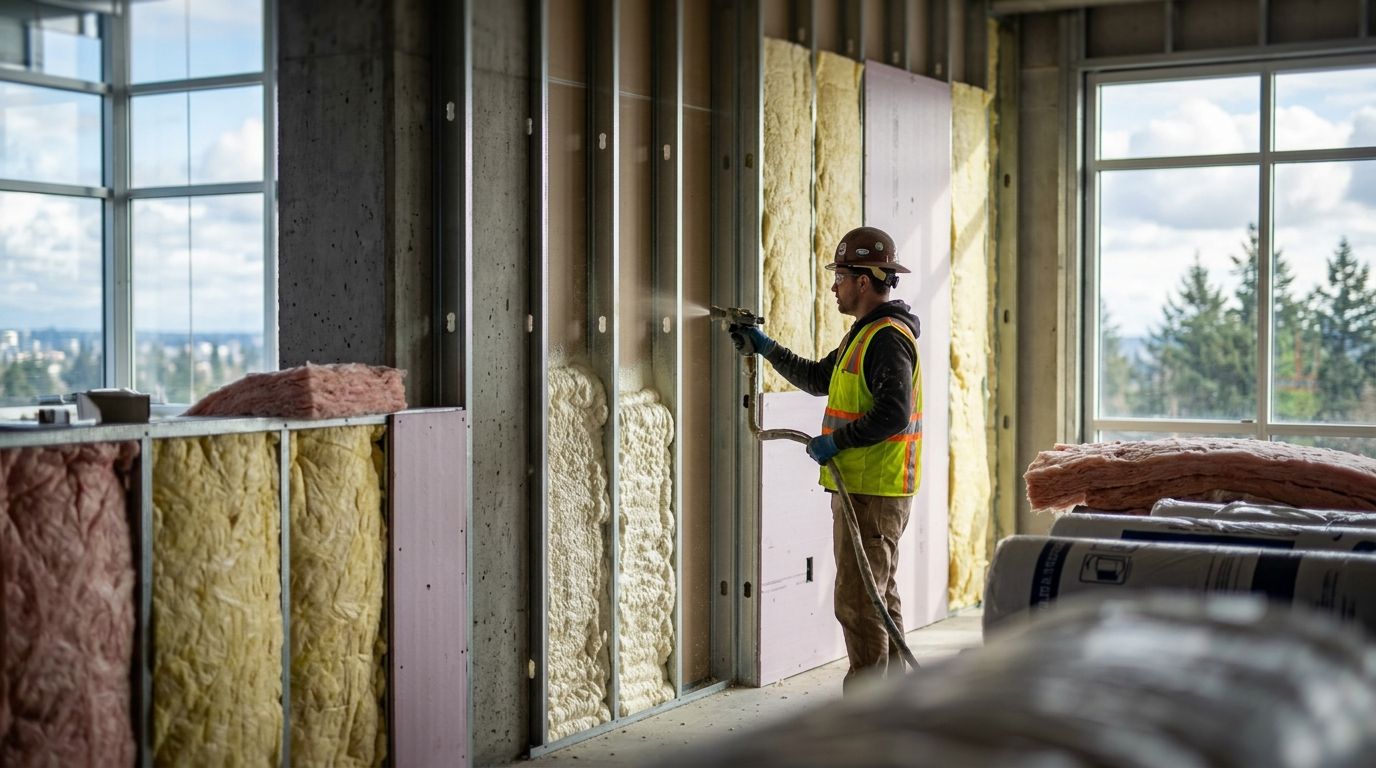
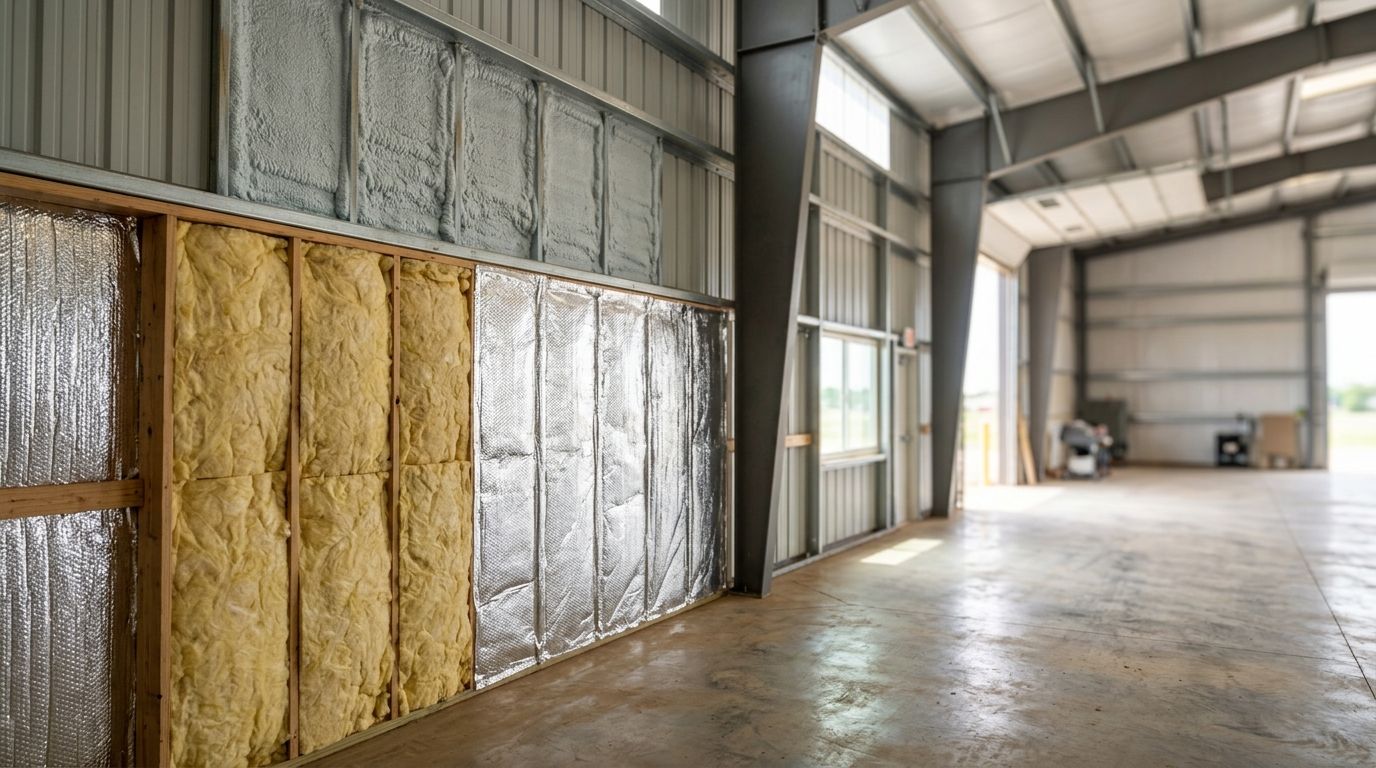
Steel doesn't insulate itself, and a pole barn or metal building without the right insulation swings 40-plus degrees between a July afternoon and a January morning while sweating condensation onto every exposed fastener. Picking the best insulation for pole barns in 2026 comes down to three questions: how much R-value per inch you need, whether the space needs a vapor barrier, and whether you're finishing it for daily use or just keeping equipment dry.
- Closed-cell spray foam is the best insulation for pole barns needing a vapor barrier and rigid wall strength.
- Open-cell spray foam wins for finished workshops and living quarters where sound control matters as much as heat loss.
- Rigid foam board is the strongest DIY option for retrofitting an existing metal building.
- Mineral wool is the safest choice near wood stoves, welding stations, or other heat sources.
- Fiberglass batts remain the budget option for simple interior partition walls.
Why this matters for pole barns and metal buildings
Metal skin has almost no R-value of its own and conducts temperature directly to whatever's behind it. That means a pole barn insulated wrong doesn't just run hot or cold — it grows condensation on the underside of the roof panels, which drips onto stored equipment, hay, or vehicles.
A contractor like AT Foam sees this pattern constantly across the Pacific Northwest: barns insulated with batts alone that still sweat because nobody addressed the vapor drive coming off damp ground or humid outside air. The insulation type matters less than whether it stops that moisture path — that's the real ranking criteria below.
What makes the best insulation for pole barns
- R-value per inch — how much resistance you get per inch of cavity depth, which matters in a 2x4 or 2x6 girt wall with limited space
- Air sealing and vapor control — whether the material also blocks air movement and moisture, or just slows heat transfer
- Condensation resistance — critical on metal roofs and walls, which sweat when warm moist air hits a cold steel surface
- Fire resistance — relevant in barns with wood stoves, welding equipment, or vehicle storage
- Structural contribution — closed-cell foam adds racking strength to a wall assembly; batts and boards add none
- DIY-friendliness — whether a landowner can install it themselves or needs a licensed crew
At a glance: pole barn insulation compared
| Insulation type | Best for | Standout feature | Key limitation |
|---|---|---|---|
| Closed-cell spray foam | Vapor barrier + structural strength | Stops condensation at under 2 inches thick | Requires professional spray equipment |
| Open-cell spray foam | Finished workshops and living space | Dampens sound between framing bays | Not a vapor barrier on its own |
| Rigid foam board | DIY metal building retrofit | Consistent R-5 per inch, cuts with a knife | Seams need taping to control air leaks |
| Mineral wool | Fire-prone areas (stoves, welding) | Handles 1,000F+ without melting | Lower R-value per inch than foam |
| Fiberglass batts | Budget interior partitions | Lowest material cost per square foot | Does nothing to stop air or moisture |
| Reflective radiant barrier | Hot-climate metal roofs | Reflects radiant heat before it enters the cavity | Adds little R-value against conductive cold |
1. Closed-cell spray foam: best insulation for pole barns needing a vapor barrier
Closed-cell spray foam expands to fill every gap in a stud or girt cavity, then cures into a rigid layer that acts as its own air and vapor barrier at roughly 2 inches of thickness. In a pole barn with exposed steel skin, that's the difference between a dry structure and one that sweats onto stored equipment every spring and fall.
Closed-cell spray foam pros:
- Rated near R-6.5 per inch, the highest of any option on this list
- Doubles as a vapor barrier, eliminating the need for separate poly sheeting
- Adds real racking strength to a wood-framed wall inside a metal building
- Doesn't absorb water, so it won't sag or lose R-value if it gets damp
Closed-cell spray foam cons:
- Needs a licensed contractor and spray rig — not a weekend DIY job
- Costs more per board foot than batts or loose fill
Best for: pole barns storing vehicles, equipment, or hay where condensation control matters most. Verdict: Buy.
2. Open-cell spray foam: best insulation for finished pole barn workshops and living quarters
Open-cell spray foam expands more than closed-cell and fills cavities at a lower cost per inch, but it stays soft and doesn't block moisture the way closed-cell does. In a pole barn converted into a workshop, man cave, or small apartment, that softer cell structure also absorbs sound between rooms far better than rigid foam or batts.
Open-cell spray foam pros:
- Expands fully into odd-shaped cavities and around wiring or plumbing
- Cuts sound transmission noticeably better than closed-cell or batts
- Air-seals the assembly even though it's not a vapor barrier
Open-cell spray foam cons:
- Rated near R-3.6 per inch, roughly half of closed-cell
- Needs a separate vapor barrier in humid Pacific Northwest climates
- Can absorb water if a roof leak goes undetected
Best for: finished interior spaces inside a pole barn where noise control matters. Verdict: Buy.
Get a spray foam quote for your barn
Free estimates for pole barn and metal building insulation across the Pacific Northwest.
3. Rigid foam board: best insulation for DIY metal building retrofits
Rigid foam board — polyiso or XPS panels — screws or glues directly to girts and purlins, making it the most practical DIY route for someone retrofitting an existing metal building without hiring a crew. XPS runs close to R-5 per inch and cuts with a utility knife.
Rigid foam board pros:
- Installs without special equipment; a homeowner can do it in a weekend
- Consistent, predictable R-value since it's a manufactured panel, not a spray
- Works over existing framing without demolition
Rigid foam board cons:
- Seams and penetrations need tape or caulk or the assembly leaks air
- Doesn't conform to irregular framing the way spray foam does
Best for: owners retrofitting an existing pole barn themselves. Verdict: Buy for DIY budgets.
4. Mineral wool: best insulation for pole barns with wood stoves or welding areas
Mineral wool, also called rock wool, is spun from basalt rock and resists fire well past 1,000F without melting or releasing toxic smoke — a real consideration in a barn that houses a wood stove, a welding bench, or an engine repair bay. It runs slightly under fiberglass in R-value per inch but handles moisture better without sagging.
Mineral wool pros:
- Fire-resistant well beyond what foam or fiberglass can handle
- Doesn't sag or lose shape when it gets damp
- Blocks sound better than fiberglass batts of the same thickness
Mineral wool cons:
- Rated around R-3.0 to R-3.3 per inch, lower than spray foam
- Costs more than standard fiberglass batts
- Doesn't air-seal on its own; still needs a vapor and air barrier
Best for: work areas with open flame, sparks, or heating equipment. Verdict: Buy for fire-prone zones.
5. Fiberglass batts: best budget insulation for interior partition walls
Fiberglass batts are the cheapest material on this list and the easiest to find at any hardware store, which makes them a reasonable choice for interior partition walls inside a pole barn that don't face outside weather. They do nothing to stop air movement or moisture, so they're a poor match for the barn's exterior envelope.
Fiberglass batts pros:
- Lowest material cost of any option here
- Widely available in standard stud-bay widths
- Simple to cut and install without tools beyond a utility knife
Fiberglass batts cons:
- Runs R-3.2 to R-3.8 per inch, similar to mineral wool but with no fire resistance advantage
- Provides zero air sealing, letting drafts move straight through
- Sags and loses R-value if it ever gets wet
Best for: interior, non-weather-facing partition walls only. Verdict: Hold — fine for interior walls, skip on the exterior envelope.
6. Reflective radiant barrier: best insulation for metal roofs in hot, sunny climates
A reflective radiant barrier is a foil-faced layer installed under the roof purlins that bounces radiant heat back before it enters the building. It does almost nothing against conductive cold in winter, but in a metal building baking under summer sun it cuts the radiant load noticeably before it ever reaches the insulation layer underneath.
Reflective radiant barrier pros:
- Reflects a large share of radiant heat before it enters the cavity
- Lightweight and easy to staple up under purlins
- Pairs well with any of the other five insulation types as a supplement
Reflective radiant barrier cons:
- Adds almost no R-value against winter heat loss
- Only works with an air gap facing the reflective side
Best for: supplementing another insulation type in hot, sun-exposed climates. Verdict: Buy as a supplement, not a standalone.
How this list was ranked
Each insulation type was ranked against the six criteria above — R-value per inch, air sealing, condensation resistance, fire resistance, structural contribution, and DIY-friendliness — rather than against a single best-overall score. That's why closed-cell and open-cell spray foam sit at the top for different reasons: one wins on moisture control and strength, the other wins on finished-space comfort. No single material wins every category, which is the honest picture in 2026.
Which insulation should you choose for your pole barn?
If the building stores vehicles, hay, or equipment and needs to stay dry, closed-cell spray foam is the default pick — it's the only option here that solves condensation and adds structural strength at the same time. If you're finishing the interior into a workshop or living space, open-cell spray foam is worth the step down in R-value for the sound control. Budget retrofits without a contractor lean on rigid foam board, and anything near an open flame belongs in mineral wool. Fiberglass batts still have a place in 2026 — just not on the exterior envelope of a metal building.
FAQ
What is the best insulation for pole barns in 2026?
Closed-cell spray foam is the best insulation for pole barns that need to stop condensation and gain structural strength, rated near R-6.5 per inch. Open-cell spray foam is the better pick when the space is finished for daily use and sound control matters.
Is spray foam better than fiberglass for metal buildings?
Yes, for the exterior envelope. Spray foam air-seals and, in the closed-cell version, blocks vapor, while fiberglass batts do neither and only make sense on interior partition walls.
How much R-value do you need for a pole barn?
It depends on climate and use, but closed-cell spray foam at 2 inches delivers roughly R-13 and also functions as a vapor barrier, which matters more in a metal building than hitting a specific R-value target alone.
Does a metal building need a vapor barrier?
Most do, since metal skin has no R-value and sweats when warm moist air meets cold steel. Closed-cell spray foam solves this by acting as its own vapor barrier; other insulation types need a separate poly or foil layer.
Can you insulate a pole barn yourself?
Rigid foam board and fiberglass batts are both DIY-friendly and require no special equipment. Spray foam, both open-cell and closed-cell, requires a licensed contractor with spray rig equipment.
What insulation is best for a pole barn workshop?
Open-cell spray foam is the best insulation for a finished pole barn workshop because it air-seals the space and dampens sound between framing bays better than rigid board or batts.
Is mineral wool fireproof for barn insulation?
Mineral wool resists fire past 1,000F without melting, making it a strong choice near wood stoves or welding stations, though it costs more than standard fiberglass batts.
Does radiant barrier insulation work in metal buildings?
Reflective radiant barriers cut radiant heat gain under a hot metal roof but add almost no protection against conductive winter cold, so they work best as a supplement to another insulation type, not a standalone solution.
One last thing
The detail most pole barn owners miss: condensation, not cold, is what actually destroys equipment and framing over time in wet climates like the Pacific Northwest. Closed-cell spray foam solves that at just under 2 inches of thickness because it crosses the vapor-barrier threshold — batts and boards never do that on their own in 2026, no matter how thick you stack them.